Teachings
Reciting Guanyin, Praying to Guanyin, Learning from Guanyin, Becoming Guanyin
Reciting Guanyin, Praying to Guanyin, Learning from Guanyin, Becoming Guanyin
Reciting Guanyin, Praying to Guanyin, Learning from Guanyin, Becoming Guanyin
by Master Sheng Yen
by Master Sheng Yen
Editor's Note
This article is excerpted from the Dharma Drum Complete Works 2020 Commemorative Edition, translated by Jerry Wang and edited by Tim Serio. Master Sheng Yen's teaching explores Guanyin Bodhisattva's central role in Chinese and Tibetan Buddhism, reminding us that Guanyin Bodhisattva’s compassion is not abstract but immediate and accessible. Whether through chanting, mantra, or the profound method of listening from the Śūraṅgama Sūtra, Guanyin meets us where we are. This article invites us to see Guanyin not only as one who rescues, but as a model for how we may embody compassion to help all beings and practice the Bodhisattva Path.
— ✦ —
According to the Āgamas, we know that during the time Shakyamuni Buddha lived in the world before he attained enlightenment, he was called a "Bodhisattva" (Chn. puti sa duo, abbreviated it as ‘pusa’). In fact, in Shakyamuni Buddha's countless past lives, he continually delivered sentient beings and was called a "Bodhisattva." In Buddhist scriptures, the term "Bodhisattva", which means a being approaching Buddhahood, isn't exclusive to Shakyamuni Buddha. There are also other revered Bodhisattvas like Maitreya Bodhisattva, Manjushri Bodhisattva, Samantabhadra Bodhisattva, Kṣitigarbha Bodhisattva, and Avalokiteshvara Bodhisattva (Chn. Guanyin Pusa). Especially Guanyin Pusa. Believing in Guanyin Pusa has always been prevalent in Chinese and Tibetan Buddhism.
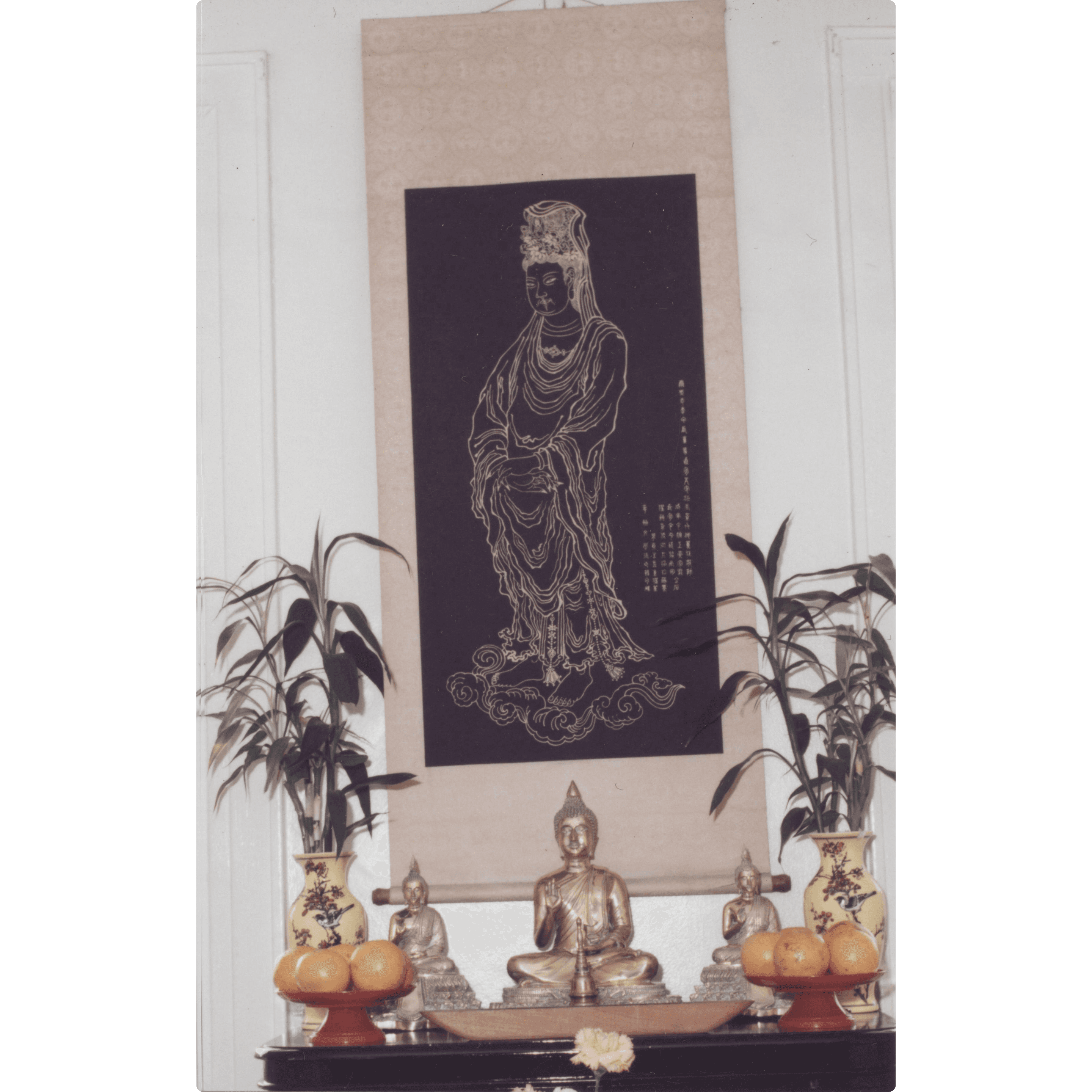
On the second floor of the old Chan Meditation Center, a small meditation hall enshrines a line drawing of Guanyin. This depiction of the Bodhisattva traveled with Master Sheng Yen from the East to the West.
The name "Avalokiteshvara" emerged very early, during the early period of Mahayana Buddhism in India. This was roughly around the time of Bodhisattva Nagarjuna. The name first appeared in the kingdom of Magadha in central India, a region where Shakyamuni Buddha frequently taught. In terms of the Western calendar, the name "Avalokiteshvara" appeared before the birth of Jesus Christ.
Reciting Guanyin: The Emergence of the Guanyin Faith
In the Sanskrit scriptures, Guanyin Pusa is referred to as "Avalokiteśvara", a being with a thousand hands and a thousand eyes. Guanyin Pusa is always ready to deliver sentient beings. How did faith in Guanyin arise? It started during Shakyamuni Buddha's time, as his teachings of compassion guided beings to find happiness from suffering, particularly liberation from the afflictions of body and mind. However, Shakyamuni also advised beings that when they lacked confidence, were deeply troubled, or faced danger or fear, they should recite the Buddha, Dharma, and Sangha — collectively known as the Three Jewels. Over time, this developed into the "Six Recollections, or Six Mindfulness 六念" (ṣaṭ-anusmṛti). The Six Recollections add three more recollections to the recollections of the Three Jewels: the help of the heavenly beings, merits of upholding the precepts, and merits of making offerings.
The Six Recollections is a very useful method. Among the Six Recollections, only mindfulness of the Buddha gradually gained widespread faith, while faith in the others faded. After Shakyamuni Buddha’s Parinirvana, his physical body no longer existed. However, people still sought the Buddha's compassionate aid and fearless salvation, which gave rise to the belief in the Bodhisattvas.
The faith in Guanyin truly represents the spirit and function of Shakyamuni Buddha’s presence in the world. Moreover, Guanyin’s compassion is not confined to a particular era or region but extends across all worlds. Whenever a sentient being recites Guanyin’s name when seeking help, Guanyin responds immediately to offer the effects of relief.
Many Buddhist sutras describe Guanyin's appearance, mainly in two ways of development. First, Guanyin Pusa teaches suffering beings and those tormented by afflictions how to find happiness by escaping suffering. This release from suffering and attainment of happiness can be understood on two levels: the suffering of life’s challenges, as well as fear, uneasiness, and insecurity, and the deeper level of suffering from ignorance and afflictions that prevent liberation. Many scriptures elaborate on Guanyin Pusa’s methods for attaining these goals.
Second, Guanyin is closely linked to Amitabha Buddha in aiding beings at the time of death and rebirth. Many people, while alive, hope to have few worries and troubles and be healthy, safe, happy, and successful. However everyone will face death, so what should we do when death comes? Although many Buddhists know to recite Amitabha’s name, few realize they can also call on Guanyin. In fact, wherever there is Amitabha Buddha, there is also Guanyin Bodhisattva. Any sutra that promotes the Pure Land or practices reciting the Buddha's name will definitely praise Guanyin Bodhisattva as well. Moreover, Guanyin Bodhisattva resides in Amitabha Buddha’s Pure Land of Ultimate Bliss (Sukhavati). Guanyin is Amitabha Buddha’s attendant and will be the future Buddha succeeding Amitabha Buddha. Therefore, many sutras state that after the nirvana of Shakyamuni Buddha, much of the salvation that sentient beings seek is obtained through faith in Guanyin.
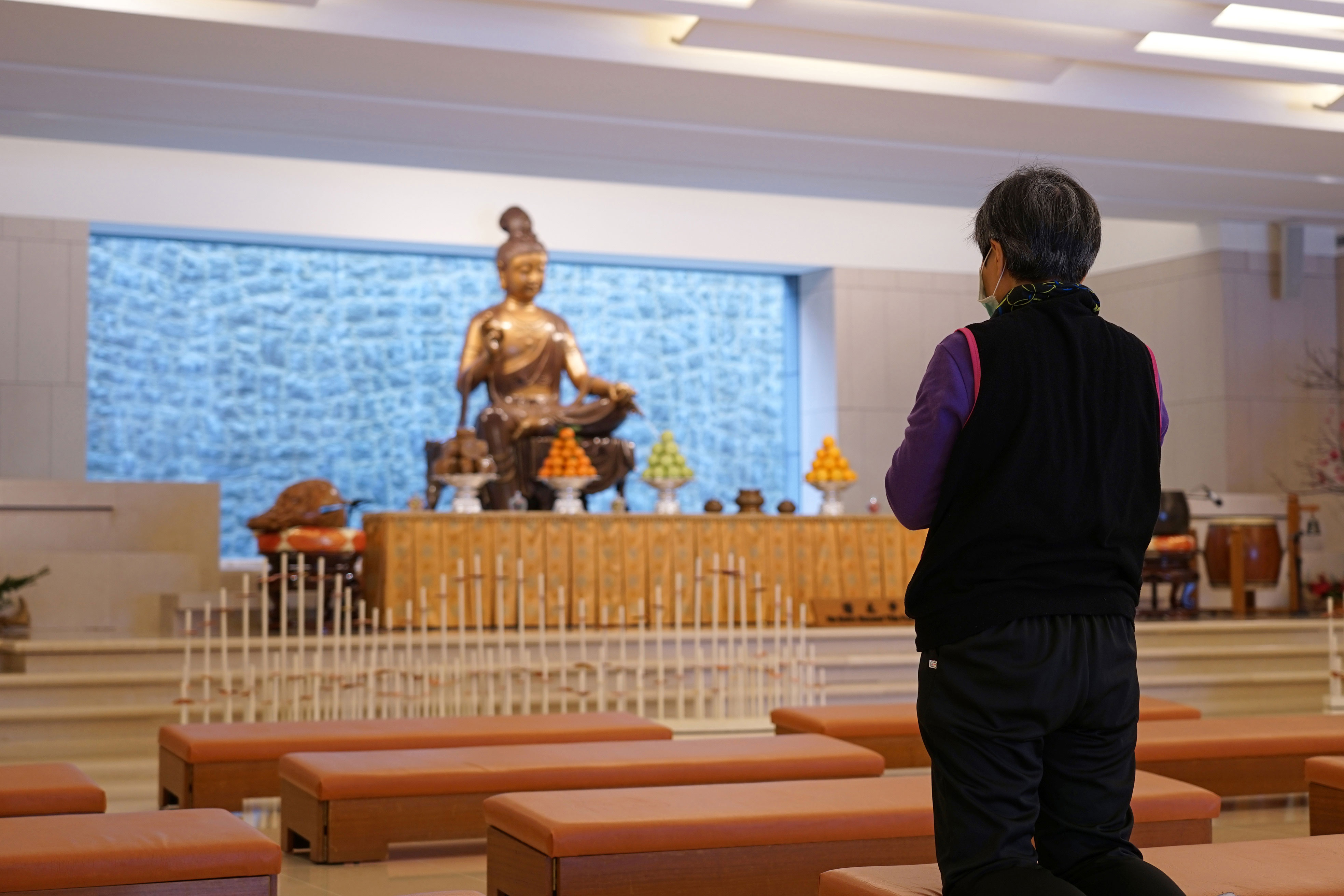
People pray to the "Wish Fulfilling Guanyin Bodhisattva” at DDM Headquarter, photo by Jane Wu
Praying to Guanyin: Guanyin is Our Nanny
Guanyin Bodhisattva is like our nanny, our protector and guardian who brings peace throughout our lives. At the time when we are going on to rebirth, Guanyin transforms into an attendant of Amitabha, guiding and receiving us to the Western Pure Land of Bliss. Upon reaching the Pure Land, Guanyin becomes a compassionate teacher. All beings who arrive there receive Guanyin’s compassionate teaching and cultivation. Even though those beings who are reborn to the “lower level of the lower class” will not personally see Amitabha, over the time, they will see Guanyin Pusa and then through Guanyin’s teaching, their karmic hindrances will gradually diminish. This allows them to eventually see their own nature and they will also be able to see Amitābha Buddha. That is due to the teachings and guidance of Guanyin Bodhisattva and other Bodhisattvas.
Throughout every stage of life—from youth to old age, from birth to death, and even after reaching the Pure Land—Guanyin Pusa's compassion is omnipresent. There are no beings that Guanyin will not save and aid. This makes the Guanyin Dharma gate unique. This is why, in both Chinese and Tibetan Buddhism, Guanyin Pusa remains the most relied upon and worshiped great Bodhisattva. Numerous scriptures encourage followers to recite Guanyin’s name and practice the Guanyin Dharma gate.
What do you think of what I have said so far? Do you feel that Guanyin Bodhisattva is like our nanny? That Guanyin Bodhisattva is always with us? Guanyin Bodhisattva has several names in Chinese, such as "Guanyin", "Guanzizai", "Guanshizizai", "Guangshiyin", "Guanshiyin Zizai", and "Guanshizizaizhe" among others.
When we face difficulties, as long as we pray to Guanyin Bodhisattva, we can immediately receive salvation. But if we do not desire to be saved, "the sesame door” will not open and even if Guanyin Bodhisattva is near, there is nothing that can be done. However, as long as we have the desire to be saved, even if we are ignorant, sinful, or humble, Guanyin Bodhisattva will certainly come to rescue us. This is because Guanyin Bodhisattva provides equal salvation to all sentient beings and is thus known as the Great Compassionate Guanyin.
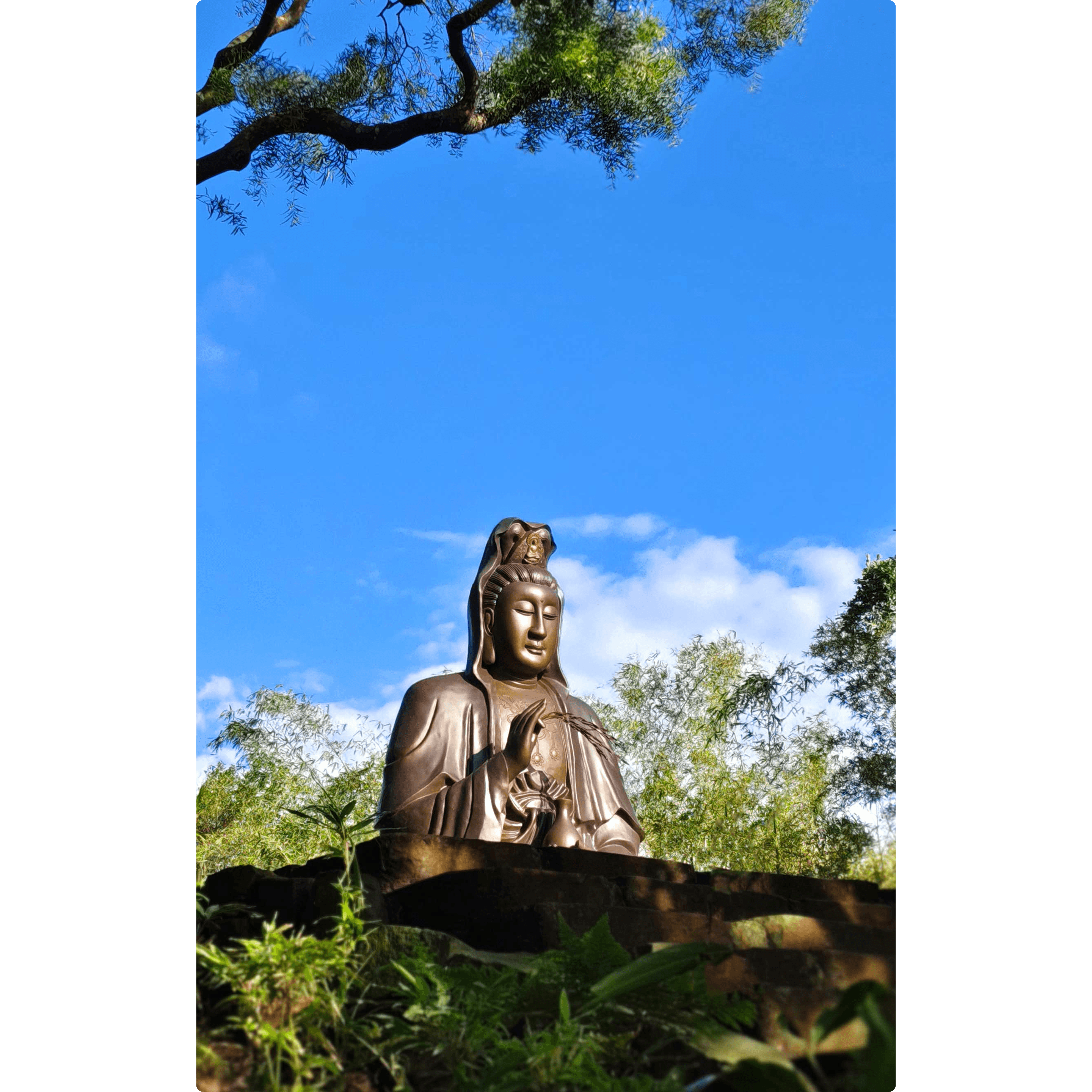
DDM Heritage Guanyin, photo by Jane Wu
Learning from Guanyin: The Practice of Guanyin Dharma Gate
As for Guanyin Bodhisattva’s methods of practice, they can range from deep to shallow, or from shallow to deep. They can involve self-reliant salvation or the power of others to save oneself. Self-reliant salvation refers to methods such as the "Perfection Penetration of the Ear-Faculty Practice Method" in the Śūraṅgama Sūtra. There are also simpler methods, such as reciting the Great Compassion Mantra, which can likewise lead to liberation, remove all karmic obstacles, and achieve the supreme Buddhahood. For worldly beings, Guanyin’s methods can be deep or shallow according to one’s situation, meaning anyone can practice these methods.
Let’s first talk about the Guanyin’s “Perfect Penetration of Ear-Faculty Method” in the Śūraṅgama Sūtra. Vol. 6. It recounts that, many kalpas ago, Guanyin Bodhisattva encountered a Guanyin Buddha. Moved by Guanyin Bodhisattva's compassion, Guanyin Buddha transmitted the method of listening, contemplating, and practicing for entering Samadhi. This is called "Hearing, Cultivating, and Developing Vajra Samadhi". This Vajra Samadhi actually begins with the stage of "entering the stream and dissolving the object". What does this mean? Whether you are reciting the Great Compassion Mantra or are chanting Guanyin Bodhisattva’s sacred name, as you continue to recite, you hear the sound, but gradually you drop the sound, and the name is no longer a separate object from you. "Entering the stream and dissolving the object" means you focus your effort, applying yourself until there is no duality in your mind, leaving only the single thought of Guanyin Bodhisattva.
When chanting Guanyin Bodhisattva’s name, you should not think of a Guanyin Bodhisattva in your mind. You chant until you forget yourself, but you are still focused on Guanyin’s sacred name. This is called "entering the stream”, where the mind is still on a single object, and the body is still on a single thought. At this moment, you should not cling to it. If you think, "I am chanting Guanyin Bodhisattva," there is still a duality, and it cannot be called "dissolving the object". The "object" here refers to the target. When you recite Guanyin’s name and forget both yourself and the name, neither seeing the name as an “object of practice” nor viewing chanting as a “method of practice,” this is called "entering the stream and dissolving the object".
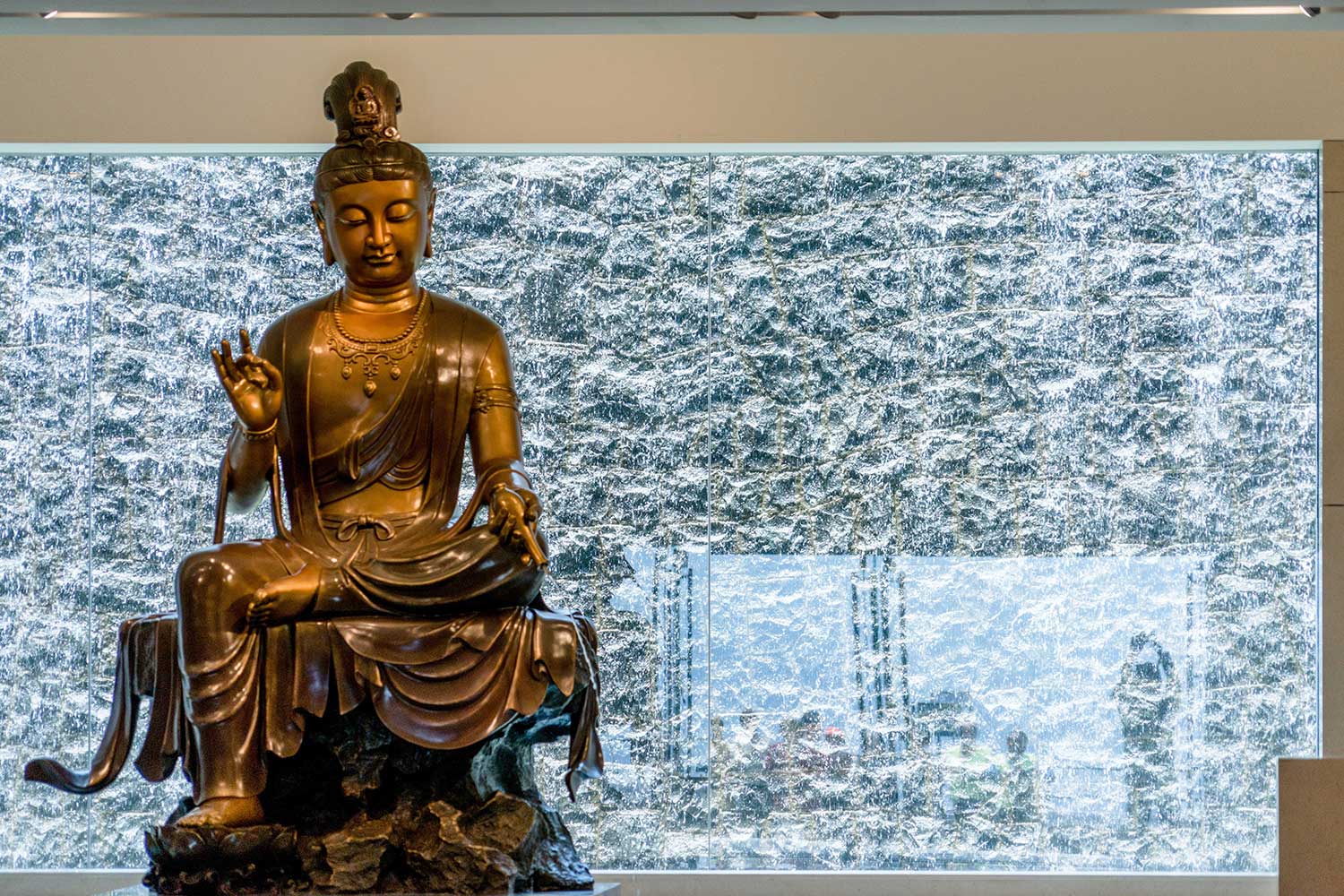
The Wish Fulfilling Guanyin at DDM Headquarter, named by our late Master Sheng Yen.
But is "entering the stream and dissolving the object" equivalent to enlightenment? Not yet, it only means that your mind is unified. After entering the stream and dissolving the object, the next step is to "turn the hearing inward to hear the self-nature". As you recite, there is sound. At this point, you hear the sound. But if you listen attentively, and eventually, you will feel as though you are no longer chanting Guanyin Bodhisattva’s name, and there is no longer the name outside your mind. You no longer rely on your ears to hear, and the sound you hear is no longer there. Instead, listen to your inner mind. What is the inner mind? It is the self-nature of no-self. The so-called self-nature is the nature of emptiness for conditional arising. The nature of emptiness means the nature of no-self. At this time, when you "turn the hearing inward to hear the self-nature", and you hear this self-nature, you’ve realized Samadhi. This is the Śūraṅgama Sūtra’s “Guanyin Perfect Penetration of Ear-Faculty Method”.
The Śūraṅgama Sūtra guides us step by step in this practice. It is the path of Guanyin Bodhisattva’s practice, which Guanyin received from the Guanyin Buddha. After mastering it, Guanyin Bodhisattva realized the "Vajra Samadhi of hearing-edification and hearing-cultivation." This is also called the "Miraculous Vajra Samadhi of hearing-edification and hearing-cultivation", or the "Omniscient Miraculous Vajra Samadhi of illusory hearing-edification and hearing-cultivation". With this Samadhi, two abilities are realized: "Upwardly, to unify the compassionate power of Tathagatas from the ten directions; downwardly, to unify the sense of awe from all beings in the six realms". After attaining this Vajra Samadhi, Guanyin Bodhisattva upwardly represents the merits and the compassionate powers of all buddhas; downwardly, he empathizes with and personally experiences the suffering, difficulties, and worries of all sentient beings. Guanyin Bodhisattva is impartial with both sentient beings and all buddhas.
In addition to the “Perfect Penetration of Ear-Faculty” Method, Guanyin Bodhisattva also teaches the practice of chanting Guanyin’s name from the Universal Gate Chapter of the Lotus Sutra and the recitation of the Great Compassionate Mantra from the Great Compassion Super Dharani Sutra. In fact, whether chanting Guanyin Bodhisattva’s name or reciting the Great Compassionate Mantra, both can fulfill our prayers, grant our requests, and free us from all fears and difficulties. Therefore, Guanyin Bodhisattva is also known as the "Giver of Fearlessness," as he bestows fearlessness on all sentient beings. Sentient beings often harbor fear, either feeling unsafe or feeling insecure. Lacking confidence, they feel anxious about their body, family, career, and all aspects of their lives, thus generating fear. The Śūraṅgama Sutra, Avatamsaka Sutra, Lotus Sutra, and the Great Compassion Dharani teach us that whenever we feel unsafe or fearful, by chanting Guanyin Bodhisattva’s name or reciting the Great Compassionate Mantra, we can be freed from all fears and difficulties.
Guanyin Bodhisattva responds to all requests. Whatever sentient beings ask for, they receive; whatever they seek to relinquish, they relinquish! For example, when you hope to eliminate certain problems or situations, praying to Guanyin and chanting Guanyin’s name will resolve the issue. For example, last year (2006), when I was ill, the medical staff discovered cancer cells in my body. They were quite anxious, and the monks and devotees of Dharma Drum Mountain were reciting the Great Compassionate Mantra, dedicating the merit to me. As a result, after one year, up until now, the cancer cells have shown no signs of progression. I believe this is due to Guanyin Bodhisattva’s protection.
Becoming Guanyin: The Bodhisattva Path as the Spirit of Mahayana Bodhisattvas
Furthermore, the Avatamsaka Sutra talks about Sudhana’s Fifty-Three Visitations, in which the twenty-eighth teacher he visited was Guanyin Bodhisattva. There are two versions of the Avatamsaka Sutra: the old and the new translations. The old version mentions Mount Petallike, while the new version refers to it as Mount Bright—located in southern India and considered Guanyin Bodhisattva’s basic abode. The Guanyin Dharma Gate in the Avatamsaka Sutra is called the Great Compassionate and Bright Dharma Gate. This is the same as the Universal Gate Chapter and the Guanyin Dharma Gate in the Surangama Sutra, teaching beings to transcend fear—both in life and at the moment of death.
In essence, whether chanting the Great Compassionate Mantra or reciting the name of Guanyin, both practices have a rescuing function. But what is the ultimate function? The Surangama Sutra clearly explains that Guanyin has thirty-two transformation bodies, through which he rescues all sentient beings seeking liberation. These thirty-two types of sentient beings all receive Guanyin’s equal assistance. Whenever sentient beings need him to manifest in any form, Guanyin appears accordingly, enabling all beings to attain liberation and fulfill the path to Buddhahood.
This is akin to Guanyin’s teaching to Sudhana in the Avatamsaka Sutra. Sudhana himself was already well-practiced and free of fear. Guanyin mainly taught him the Guanyin Dharma Gate: to use the great and equal compassion to liberate all beings, and through this compassion, to help beings achieve enlightenment—thus practicing the Bodhisattva Path.
Practicing the Bodhisattva Path is the core of the Guanyin Dharma Gate. For those of us practicing Guanyin’s Dharma Gate, if we only seek personal security, smoothness in life, freedom from illness, and ask to help raise intelligent, obedient children and succeed in business. That is selfish and not in line with the Bodhisattva Path. Although I often encourage everyone to seek Guanyin’s help, chant his name, or recite the Great Compassionate Mantra in situations where they lack confidence, self-control, or the ability to resolve their own troubles, our ultimate goal in practicing Guanyin’s Dharma Gate should be to follow the Bodhisattva Path. Sudhana visited Guanyin not to fulfill personal desires but to learn how to experience and manifest the Buddha’s great compassion, to help all beings detach from suffering and attain joy, and to fulfill Buddhahood through the practice of the Bodhisattva Path. This is the Great Compassionate Dharma Gate of Guanyin.
The Great Compassionate Dharma Gate of Guanyin must be impartial. In 2005, at the grand opening of the Dharma Drum Mountain Taiwan Headquarters, the main theme was “Arising the Great Compassionate Mind”. This theme carries immense and profound meaning. For example, the Guanyin Hall at the Dharma Drum Mountain Taiwan Headquarters displays three inscriptions. The first one, “Entering the Stream and Dissolving the Object”, encourages us to practice Guanyin’s Dharma Gate. The second, “Arising the Great Compassionate Mind”, calls on us to use this compassionate mind to equally liberate all beings and rescue the world. The third inscription, “Omnipresence of Guanyin” reminds us to help all beings in the six realms, wherever and whenever, as long as a being faces difficulty—this is the essence of Guanyin’s impartial compassionate Dharma Gate. Just like “a thousand rivers reflecting a thousand moons”, Guanyin pervades all worlds, saving all beings in the six realms.
Shouldn’t we follow Guanyin’s boundless compassion? If we aspire to connect with Guanyin, we must practice Guanyin’s Dharma Gate. Otherwise, merely praying for personal gain, although useful, will not lead to liberation or Buddhahood, and one will not be a practitioner of the Bodhisattva Path.
The spirit of the Mahayana Bodhisattva Path is to recite (remembrance/mindfulness of) the Bodhisattva's name, pray to the Bodhisattva, learn from the Bodhisattva, and become a Bodhisattva. This is the proactive approach to the cultivation of the Bodhisattva Path. Simply reciting the Bodhisattva's name, praying for personal and family peace and happiness, and wishing that Amitabha and Guanyin will come to guide us at the moment of death, this is not the practice of the Bodhisattva Path. Let me tell you: those waiting for Amitabha to personally come at death must have karmic capacity of Upper Class (上品). Those of Middle Class (中品) or Lower Class (下品) will only meet Guanyin first. If we continuously recite Guanyin’s name and have faith in Guanyin, Guanyin will protect us from life to death and guide us until we attain enlightenment and Buddhahood. Lifetime after lifetime, Guanyin is our guardian.
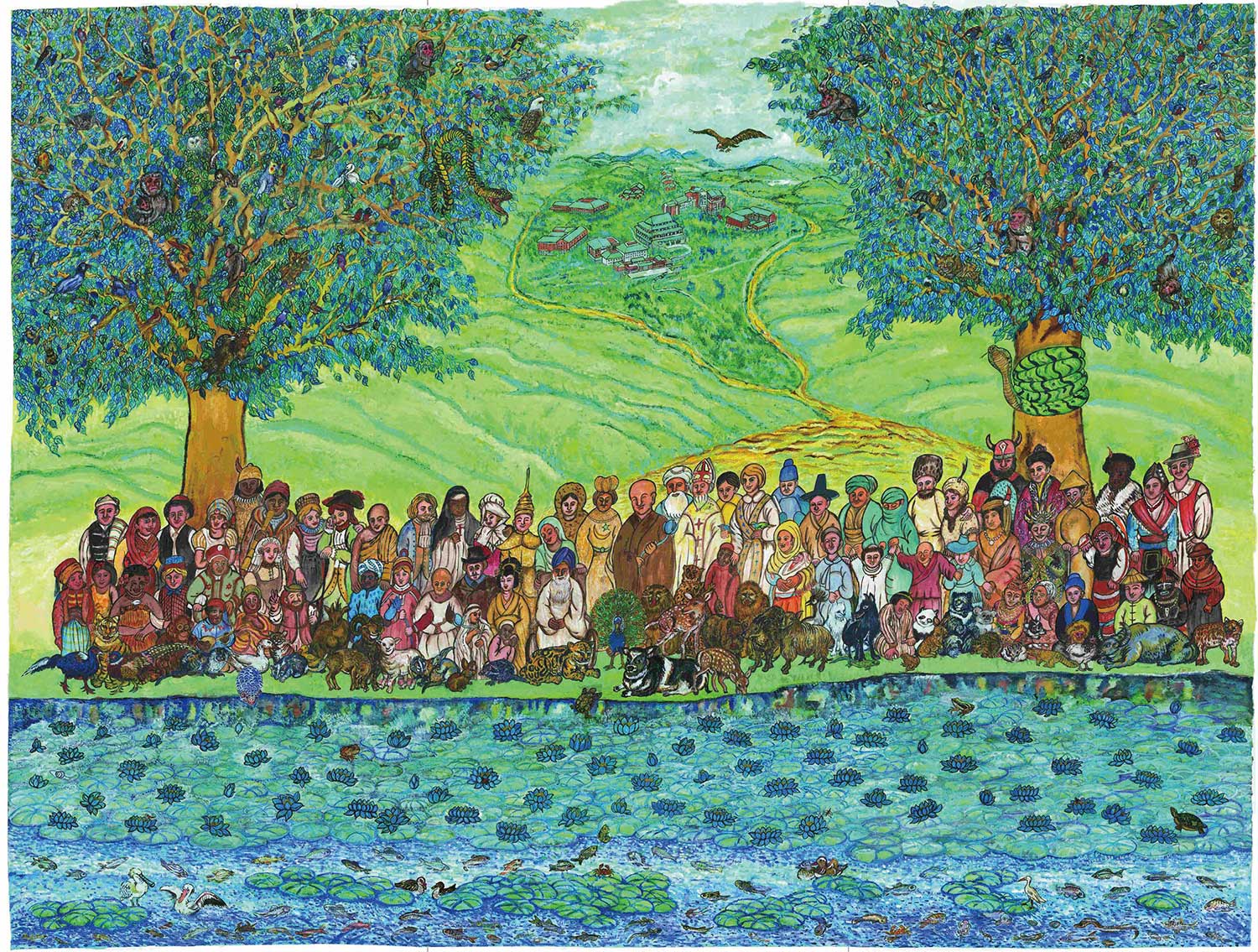
The painting “Pure Land on Earth” was conceived by Master Sheng Yen and created by renowned ceramic artist Lien Pao-Tsai.
Regarding Guanyin’s role alongside Amitabha Buddha, this is discussed in the Infinite Life Sutra, the Guanyin Bodhisattva Prediction (vyākaraṇa) Sutra, and the White Lotus of Compassion (Karuṇāpuṇḍarīka 悲華經). The White Lotus of Compassion tells us that long ago, a Tathagata was a Wheel-turning Holy King with a thousand sons in his past life. His eldest son, named “No Look Back” was called Guanyin after leaving home. This holy king was indeed the Amitabha Buddha. That’s why, after Guanyin attaining Buddhahood, he will become the Chief teacher of the Western Pure Land of Ultimate Bliss and continue to liberate beings there.
The Sutra of Contemplating the Buddha of Immeasurable life also mentions Guanyin wearing a jeweled crown, with an image of Amitabha Buddha on it. This immense Guanyin radiates light, and within his halo are many Bodhisattvas, heavenly beings, and sentient beings, all listening to the teachings of the Buddhas. This suggests that Guanyin’s virtue is equal to that of all Buddhas.
Today, as I discuss Guanyin’s Dharma Gate, I hope everyone will recite Guanyin’s name, pray to Guanyin, learn from Guanyin, and then become Guanyin. Guanyin has not just thirty-two transformation bodies, but countless manifestations, infinite hands and eyes, rescuing beings everywhere all the time. What do Guanyin’s manifestations look like? You, I, and others—any of us can be a manifestation of Guanyin. As long as we use the Guanyin Dharma Gate to treat others with an impartial compassionate mind, we will become his manifestations. Thus, I often encourage everyone: each of us can become a manifestation of Guanyin. I acknowledge that I am one—what about you?
(Guanyin Bodhisattva's Ordination Day Lecture given in New York Chan Meditation Center (Dongchu Buddhist Temple) on November 9, 2006, published in the Issue #312 of Life Magazine)
— ✦ —
Editor's Note
This article is excerpted from the Dharma Drum Complete Works 2020 Commemorative Edition, translated by Jerry Wang and edited by Tim Serio. Master Sheng Yen's teaching explores Guanyin Bodhisattva's central role in Chinese and Tibetan Buddhism, reminding us that Guanyin Bodhisattva’s compassion is not abstract but immediate and accessible. Whether through chanting, mantra, or the profound method of listening from the Śūraṅgama Sūtra, Guanyin meets us where we are. This article invites us to see Guanyin not only as one who rescues, but as a model for how we may embody compassion to help all beings and practice the Bodhisattva Path.
— ✦ —
According to the Āgamas, we know that during the time Shakyamuni Buddha lived in the world before he attained enlightenment, he was called a "Bodhisattva" (Chn. puti sa duo, abbreviated it as ‘pusa’). In fact, in Shakyamuni Buddha's countless past lives, he continually delivered sentient beings and was called a "Bodhisattva." In Buddhist scriptures, the term "Bodhisattva", which means a being approaching Buddhahood, isn't exclusive to Shakyamuni Buddha. There are also other revered Bodhisattvas like Maitreya Bodhisattva, Manjushri Bodhisattva, Samantabhadra Bodhisattva, Kṣitigarbha Bodhisattva, and Avalokiteshvara Bodhisattva (Chn. Guanyin Pusa). Especially Guanyin Pusa. Believing in Guanyin Pusa has always been prevalent in Chinese and Tibetan Buddhism.
On the second floor of the old Chan Meditation Center, a small meditation hall enshrines a line drawing of Guanyin. This depiction of the Bodhisattva traveled with Master Sheng Yen from the East to the West.
The name "Avalokiteshvara" emerged very early, during the early period of Mahayana Buddhism in India. This was roughly around the time of Bodhisattva Nagarjuna. The name first appeared in the kingdom of Magadha in central India, a region where Shakyamuni Buddha frequently taught. In terms of the Western calendar, the name "Avalokiteshvara" appeared before the birth of Jesus Christ.
Reciting Guanyin: The Emergence of the Guanyin Faith
In the Sanskrit scriptures, Guanyin Pusa is referred to as "Avalokiteśvara", a being with a thousand hands and a thousand eyes. Guanyin Pusa is always ready to deliver sentient beings. How did faith in Guanyin arise? It started during Shakyamuni Buddha's time, as his teachings of compassion guided beings to find happiness from suffering, particularly liberation from the afflictions of body and mind. However, Shakyamuni also advised beings that when they lacked confidence, were deeply troubled, or faced danger or fear, they should recite the Buddha, Dharma, and Sangha — collectively known as the Three Jewels. Over time, this developed into the "Six Recollections, or Six Mindfulness 六念" (ṣaṭ-anusmṛti). The Six Recollections add three more recollections to the recollections of the Three Jewels: the help of the heavenly beings, merits of upholding the precepts, and merits of making offerings.
The Six Recollections is a very useful method. Among the Six Recollections, only mindfulness of the Buddha gradually gained widespread faith, while faith in the others faded. After Shakyamuni Buddha’s Parinirvana, his physical body no longer existed. However, people still sought the Buddha's compassionate aid and fearless salvation, which gave rise to the belief in the Bodhisattvas.
The faith in Guanyin truly represents the spirit and function of Shakyamuni Buddha’s presence in the world. Moreover, Guanyin’s compassion is not confined to a particular era or region but extends across all worlds. Whenever a sentient being recites Guanyin’s name when seeking help, Guanyin responds immediately to offer the effects of relief.
Many Buddhist sutras describe Guanyin's appearance, mainly in two ways of development. First, Guanyin Pusa teaches suffering beings and those tormented by afflictions how to find happiness by escaping suffering. This release from suffering and attainment of happiness can be understood on two levels: the suffering of life’s challenges, as well as fear, uneasiness, and insecurity, and the deeper level of suffering from ignorance and afflictions that prevent liberation. Many scriptures elaborate on Guanyin Pusa’s methods for attaining these goals.
Second, Guanyin is closely linked to Amitabha Buddha in aiding beings at the time of death and rebirth. Many people, while alive, hope to have few worries and troubles and be healthy, safe, happy, and successful. However everyone will face death, so what should we do when death comes? Although many Buddhists know to recite Amitabha’s name, few realize they can also call on Guanyin. In fact, wherever there is Amitabha Buddha, there is also Guanyin Bodhisattva. Any sutra that promotes the Pure Land or practices reciting the Buddha's name will definitely praise Guanyin Bodhisattva as well. Moreover, Guanyin Bodhisattva resides in Amitabha Buddha’s Pure Land of Ultimate Bliss (Sukhavati). Guanyin is Amitabha Buddha’s attendant and will be the future Buddha succeeding Amitabha Buddha. Therefore, many sutras state that after the nirvana of Shakyamuni Buddha, much of the salvation that sentient beings seek is obtained through faith in Guanyin.
People pray to the "Wish Fulfilling Guanyin Bodhisattva” at DDM Headquarter, photo by Jane Wu
Praying to Guanyin: Guanyin is Our Nanny
Guanyin Bodhisattva is like our nanny, our protector and guardian who brings peace throughout our lives. At the time when we are going on to rebirth, Guanyin transforms into an attendant of Amitabha, guiding and receiving us to the Western Pure Land of Bliss. Upon reaching the Pure Land, Guanyin becomes a compassionate teacher. All beings who arrive there receive Guanyin’s compassionate teaching and cultivation. Even though those beings who are reborn to the “lower level of the lower class” will not personally see Amitabha, over the time, they will see Guanyin Pusa and then through Guanyin’s teaching, their karmic hindrances will gradually diminish. This allows them to eventually see their own nature and they will also be able to see Amitābha Buddha. That is due to the teachings and guidance of Guanyin Bodhisattva and other Bodhisattvas.
Throughout every stage of life—from youth to old age, from birth to death, and even after reaching the Pure Land—Guanyin Pusa's compassion is omnipresent. There are no beings that Guanyin will not save and aid. This makes the Guanyin Dharma gate unique. This is why, in both Chinese and Tibetan Buddhism, Guanyin Pusa remains the most relied upon and worshiped great Bodhisattva. Numerous scriptures encourage followers to recite Guanyin’s name and practice the Guanyin Dharma gate.
What do you think of what I have said so far? Do you feel that Guanyin Bodhisattva is like our nanny? That Guanyin Bodhisattva is always with us? Guanyin Bodhisattva has several names in Chinese, such as "Guanyin", "Guanzizai", "Guanshizizai", "Guangshiyin", "Guanshiyin Zizai", and "Guanshizizaizhe" among others.
When we face difficulties, as long as we pray to Guanyin Bodhisattva, we can immediately receive salvation. But if we do not desire to be saved, "the sesame door” will not open and even if Guanyin Bodhisattva is near, there is nothing that can be done. However, as long as we have the desire to be saved, even if we are ignorant, sinful, or humble, Guanyin Bodhisattva will certainly come to rescue us. This is because Guanyin Bodhisattva provides equal salvation to all sentient beings and is thus known as the Great Compassionate Guanyin.
DDM Heritage Guanyin, photo by Jane Wu
Learning from Guanyin: The Practice of Guanyin Dharma Gate
As for Guanyin Bodhisattva’s methods of practice, they can range from deep to shallow, or from shallow to deep. They can involve self-reliant salvation or the power of others to save oneself. Self-reliant salvation refers to methods such as the "Perfection Penetration of the Ear-Faculty Practice Method" in the Śūraṅgama Sūtra. There are also simpler methods, such as reciting the Great Compassion Mantra, which can likewise lead to liberation, remove all karmic obstacles, and achieve the supreme Buddhahood. For worldly beings, Guanyin’s methods can be deep or shallow according to one’s situation, meaning anyone can practice these methods.
Let’s first talk about the Guanyin’s “Perfect Penetration of Ear-Faculty Method” in the Śūraṅgama Sūtra. Vol. 6. It recounts that, many kalpas ago, Guanyin Bodhisattva encountered a Guanyin Buddha. Moved by Guanyin Bodhisattva's compassion, Guanyin Buddha transmitted the method of listening, contemplating, and practicing for entering Samadhi. This is called "Hearing, Cultivating, and Developing Vajra Samadhi". This Vajra Samadhi actually begins with the stage of "entering the stream and dissolving the object". What does this mean? Whether you are reciting the Great Compassion Mantra or are chanting Guanyin Bodhisattva’s sacred name, as you continue to recite, you hear the sound, but gradually you drop the sound, and the name is no longer a separate object from you. "Entering the stream and dissolving the object" means you focus your effort, applying yourself until there is no duality in your mind, leaving only the single thought of Guanyin Bodhisattva.
When chanting Guanyin Bodhisattva’s name, you should not think of a Guanyin Bodhisattva in your mind. You chant until you forget yourself, but you are still focused on Guanyin’s sacred name. This is called "entering the stream”, where the mind is still on a single object, and the body is still on a single thought. At this moment, you should not cling to it. If you think, "I am chanting Guanyin Bodhisattva," there is still a duality, and it cannot be called "dissolving the object". The "object" here refers to the target. When you recite Guanyin’s name and forget both yourself and the name, neither seeing the name as an “object of practice” nor viewing chanting as a “method of practice,” this is called "entering the stream and dissolving the object".
The Wish Fulfilling Guanyin at DDM Headquarter, named by our late Master Sheng Yen.
But is "entering the stream and dissolving the object" equivalent to enlightenment? Not yet, it only means that your mind is unified. After entering the stream and dissolving the object, the next step is to "turn the hearing inward to hear the self-nature". As you recite, there is sound. At this point, you hear the sound. But if you listen attentively, and eventually, you will feel as though you are no longer chanting Guanyin Bodhisattva’s name, and there is no longer the name outside your mind. You no longer rely on your ears to hear, and the sound you hear is no longer there. Instead, listen to your inner mind. What is the inner mind? It is the self-nature of no-self. The so-called self-nature is the nature of emptiness for conditional arising. The nature of emptiness means the nature of no-self. At this time, when you "turn the hearing inward to hear the self-nature", and you hear this self-nature, you’ve realized Samadhi. This is the Śūraṅgama Sūtra’s “Guanyin Perfect Penetration of Ear-Faculty Method”.
The Śūraṅgama Sūtra guides us step by step in this practice. It is the path of Guanyin Bodhisattva’s practice, which Guanyin received from the Guanyin Buddha. After mastering it, Guanyin Bodhisattva realized the "Vajra Samadhi of hearing-edification and hearing-cultivation." This is also called the "Miraculous Vajra Samadhi of hearing-edification and hearing-cultivation", or the "Omniscient Miraculous Vajra Samadhi of illusory hearing-edification and hearing-cultivation". With this Samadhi, two abilities are realized: "Upwardly, to unify the compassionate power of Tathagatas from the ten directions; downwardly, to unify the sense of awe from all beings in the six realms". After attaining this Vajra Samadhi, Guanyin Bodhisattva upwardly represents the merits and the compassionate powers of all buddhas; downwardly, he empathizes with and personally experiences the suffering, difficulties, and worries of all sentient beings. Guanyin Bodhisattva is impartial with both sentient beings and all buddhas.
In addition to the “Perfect Penetration of Ear-Faculty” Method, Guanyin Bodhisattva also teaches the practice of chanting Guanyin’s name from the Universal Gate Chapter of the Lotus Sutra and the recitation of the Great Compassionate Mantra from the Great Compassion Super Dharani Sutra. In fact, whether chanting Guanyin Bodhisattva’s name or reciting the Great Compassionate Mantra, both can fulfill our prayers, grant our requests, and free us from all fears and difficulties. Therefore, Guanyin Bodhisattva is also known as the "Giver of Fearlessness," as he bestows fearlessness on all sentient beings. Sentient beings often harbor fear, either feeling unsafe or feeling insecure. Lacking confidence, they feel anxious about their body, family, career, and all aspects of their lives, thus generating fear. The Śūraṅgama Sutra, Avatamsaka Sutra, Lotus Sutra, and the Great Compassion Dharani teach us that whenever we feel unsafe or fearful, by chanting Guanyin Bodhisattva’s name or reciting the Great Compassionate Mantra, we can be freed from all fears and difficulties.
Guanyin Bodhisattva responds to all requests. Whatever sentient beings ask for, they receive; whatever they seek to relinquish, they relinquish! For example, when you hope to eliminate certain problems or situations, praying to Guanyin and chanting Guanyin’s name will resolve the issue. For example, last year (2006), when I was ill, the medical staff discovered cancer cells in my body. They were quite anxious, and the monks and devotees of Dharma Drum Mountain were reciting the Great Compassionate Mantra, dedicating the merit to me. As a result, after one year, up until now, the cancer cells have shown no signs of progression. I believe this is due to Guanyin Bodhisattva’s protection.
Becoming Guanyin: The Bodhisattva Path as the Spirit of Mahayana Bodhisattvas
Furthermore, the Avatamsaka Sutra talks about Sudhana’s Fifty-Three Visitations, in which the twenty-eighth teacher he visited was Guanyin Bodhisattva. There are two versions of the Avatamsaka Sutra: the old and the new translations. The old version mentions Mount Petallike, while the new version refers to it as Mount Bright—located in southern India and considered Guanyin Bodhisattva’s basic abode. The Guanyin Dharma Gate in the Avatamsaka Sutra is called the Great Compassionate and Bright Dharma Gate. This is the same as the Universal Gate Chapter and the Guanyin Dharma Gate in the Surangama Sutra, teaching beings to transcend fear—both in life and at the moment of death.
In essence, whether chanting the Great Compassionate Mantra or reciting the name of Guanyin, both practices have a rescuing function. But what is the ultimate function? The Surangama Sutra clearly explains that Guanyin has thirty-two transformation bodies, through which he rescues all sentient beings seeking liberation. These thirty-two types of sentient beings all receive Guanyin’s equal assistance. Whenever sentient beings need him to manifest in any form, Guanyin appears accordingly, enabling all beings to attain liberation and fulfill the path to Buddhahood.
This is akin to Guanyin’s teaching to Sudhana in the Avatamsaka Sutra. Sudhana himself was already well-practiced and free of fear. Guanyin mainly taught him the Guanyin Dharma Gate: to use the great and equal compassion to liberate all beings, and through this compassion, to help beings achieve enlightenment—thus practicing the Bodhisattva Path.
Practicing the Bodhisattva Path is the core of the Guanyin Dharma Gate. For those of us practicing Guanyin’s Dharma Gate, if we only seek personal security, smoothness in life, freedom from illness, and ask to help raise intelligent, obedient children and succeed in business. That is selfish and not in line with the Bodhisattva Path. Although I often encourage everyone to seek Guanyin’s help, chant his name, or recite the Great Compassionate Mantra in situations where they lack confidence, self-control, or the ability to resolve their own troubles, our ultimate goal in practicing Guanyin’s Dharma Gate should be to follow the Bodhisattva Path. Sudhana visited Guanyin not to fulfill personal desires but to learn how to experience and manifest the Buddha’s great compassion, to help all beings detach from suffering and attain joy, and to fulfill Buddhahood through the practice of the Bodhisattva Path. This is the Great Compassionate Dharma Gate of Guanyin.
The Great Compassionate Dharma Gate of Guanyin must be impartial. In 2005, at the grand opening of the Dharma Drum Mountain Taiwan Headquarters, the main theme was “Arising the Great Compassionate Mind”. This theme carries immense and profound meaning. For example, the Guanyin Hall at the Dharma Drum Mountain Taiwan Headquarters displays three inscriptions. The first one, “Entering the Stream and Dissolving the Object”, encourages us to practice Guanyin’s Dharma Gate. The second, “Arising the Great Compassionate Mind”, calls on us to use this compassionate mind to equally liberate all beings and rescue the world. The third inscription, “Omnipresence of Guanyin” reminds us to help all beings in the six realms, wherever and whenever, as long as a being faces difficulty—this is the essence of Guanyin’s impartial compassionate Dharma Gate. Just like “a thousand rivers reflecting a thousand moons”, Guanyin pervades all worlds, saving all beings in the six realms.
Shouldn’t we follow Guanyin’s boundless compassion? If we aspire to connect with Guanyin, we must practice Guanyin’s Dharma Gate. Otherwise, merely praying for personal gain, although useful, will not lead to liberation or Buddhahood, and one will not be a practitioner of the Bodhisattva Path.
The spirit of the Mahayana Bodhisattva Path is to recite (remembrance/mindfulness of) the Bodhisattva's name, pray to the Bodhisattva, learn from the Bodhisattva, and become a Bodhisattva. This is the proactive approach to the cultivation of the Bodhisattva Path. Simply reciting the Bodhisattva's name, praying for personal and family peace and happiness, and wishing that Amitabha and Guanyin will come to guide us at the moment of death, this is not the practice of the Bodhisattva Path. Let me tell you: those waiting for Amitabha to personally come at death must have karmic capacity of Upper Class (上品). Those of Middle Class (中品) or Lower Class (下品) will only meet Guanyin first. If we continuously recite Guanyin’s name and have faith in Guanyin, Guanyin will protect us from life to death and guide us until we attain enlightenment and Buddhahood. Lifetime after lifetime, Guanyin is our guardian.
The painting “Pure Land on Earth” was conceived by Master Sheng Yen and created by renowned ceramic artist Lien Pao-Tsai.
Regarding Guanyin’s role alongside Amitabha Buddha, this is discussed in the Infinite Life Sutra, the Guanyin Bodhisattva Prediction (vyākaraṇa) Sutra, and the White Lotus of Compassion (Karuṇāpuṇḍarīka 悲華經). The White Lotus of Compassion tells us that long ago, a Tathagata was a Wheel-turning Holy King with a thousand sons in his past life. His eldest son, named “No Look Back” was called Guanyin after leaving home. This holy king was indeed the Amitabha Buddha. That’s why, after Guanyin attaining Buddhahood, he will become the Chief teacher of the Western Pure Land of Ultimate Bliss and continue to liberate beings there.
The Sutra of Contemplating the Buddha of Immeasurable life also mentions Guanyin wearing a jeweled crown, with an image of Amitabha Buddha on it. This immense Guanyin radiates light, and within his halo are many Bodhisattvas, heavenly beings, and sentient beings, all listening to the teachings of the Buddhas. This suggests that Guanyin’s virtue is equal to that of all Buddhas.
Today, as I discuss Guanyin’s Dharma Gate, I hope everyone will recite Guanyin’s name, pray to Guanyin, learn from Guanyin, and then become Guanyin. Guanyin has not just thirty-two transformation bodies, but countless manifestations, infinite hands and eyes, rescuing beings everywhere all the time. What do Guanyin’s manifestations look like? You, I, and others—any of us can be a manifestation of Guanyin. As long as we use the Guanyin Dharma Gate to treat others with an impartial compassionate mind, we will become his manifestations. Thus, I often encourage everyone: each of us can become a manifestation of Guanyin. I acknowledge that I am one—what about you?
(Guanyin Bodhisattva's Ordination Day Lecture given in New York Chan Meditation Center (Dongchu Buddhist Temple) on November 9, 2006, published in the Issue #312 of Life Magazine)
— ✦ —
Get Chan Magazine sent to your inbox
Once quarterly
Please check your mailbox to confirm your subscription after clicking Subscribe.
Get Chan Magazine sent to your inbox
Once quarterly
Please check your mailbox to confirm your subscription after clicking Subscribe.