reflective
From Dependent Origination to Awareness: A Learning Journey Back to the Source of Life
From Dependent Origination to Awareness: A Learning Journey Back to the Source of Life
From Dependent Origination to Awareness: A Learning Journey Back to the Source of Life
By Holly Li
By Holly Li
Editor’s Note
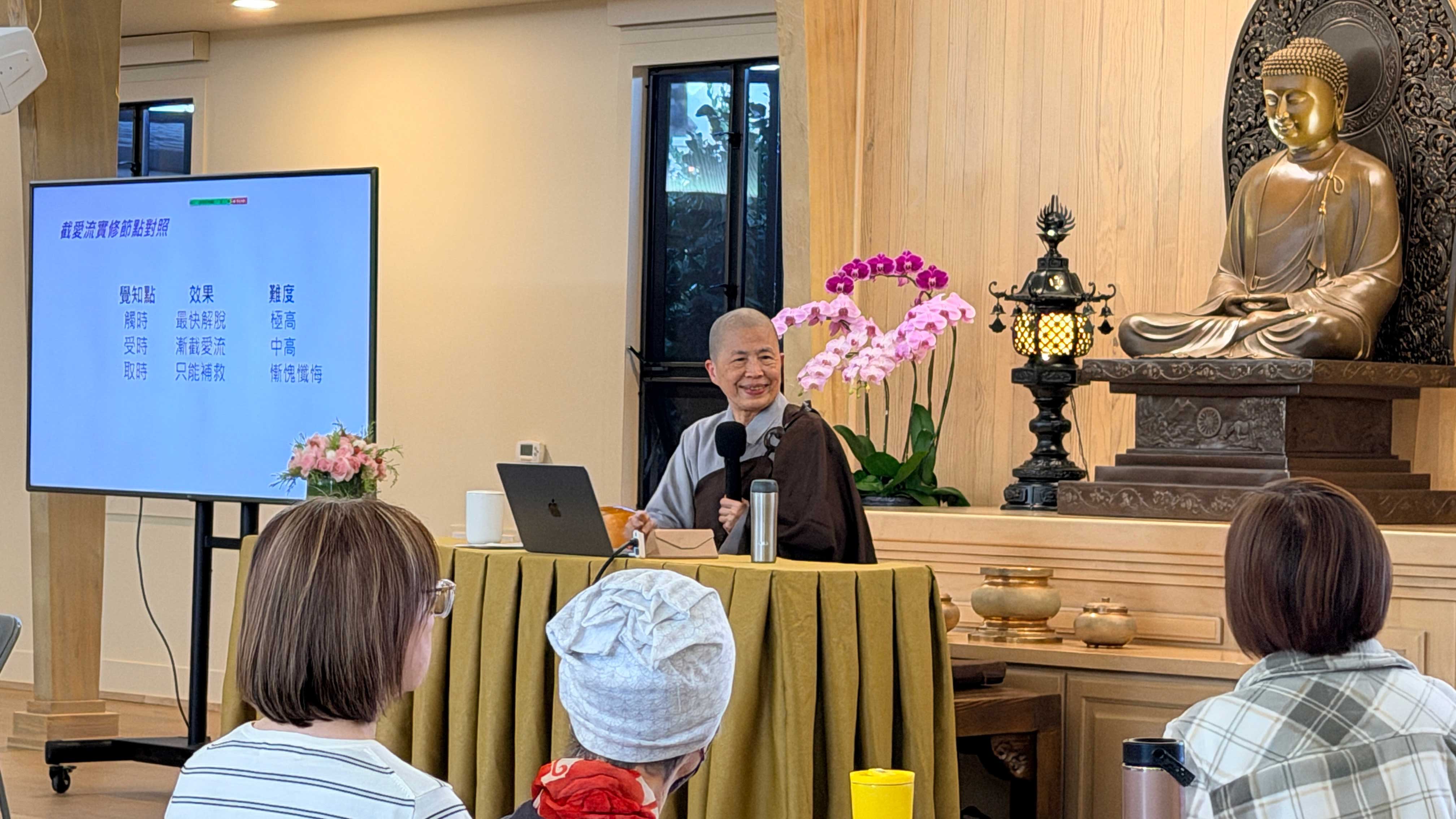
Holly Li, a volunteer with the Dharma Drum Mountain Los Angeles Center, participated in a lecture by Venerable Guo Goang on the Āgamas on January 10–11, 2026. The author shares profound insights gathered from the teachings. Moving beyond abstract theory, the piece explores the early Buddhist scriptures as a practical, almost scientific framework for understanding the mechanics of suffering and liberation. Edited by Edward Lin.
— ✦ —
From January 10 to 11, 2026, listening to Venerable Guo Goang (Fashi) teach the Āgama scriptures was a learning process of being continuously “brought back to the roots.” If one does not understand the Āgamas, it is difficult to understand the Mahāyāna. This is not about elevating the early teachings, but a reminder: if one does not understand the most fundamental principles and logic of Buddhist practice, even the grandest theories may remain mere conceptual excitement, unable to truly transform life.
The Āgama scriptures are regarded as among the earliest teachings precisely because they do not go in circles or indulge in lyrical expression. They speak of principles, methods, and discernment, with only one aim—ultimate peace and happiness. “Ultimate” does not mean temporary emotional relief, but a stable fruit of liberation that does not fluctuate with conditions. Yet the fruit does not arise on its own; it requires the complete presence of causes and conditions. This clear causality and logical precision give the Āgamas an almost scientific spirit of rationality.
During the teaching, Fashi continually distinguished between “principle” and “phenomena.” Principle refers to unchanging, universally applicable truths. Phenomena refer to methods of practice established according to different people and times. This resonates deeply with traditional Chinese thought. The distinction in the I Ching between the Dao and its instruments expresses the same idea. The Dao does not change with individuals, but the instruments must be adapted to them. The eighty-four thousand Dharma doors are not chaotic; they are applications of the same principle in different states of life. The core that runs through them is dependent origination and non-self, and its concentrated expressions are the twelve links of dependent origination and the four noble truths.
What I found myself repeatedly reflecting on was Fashi’s emphasis on the elements of awakening: urgency and wise attention. Urgency is not a craving for mystical experiences, but a deep desire to understand the truth of life—a determination no longer to live superficially. In Confucianism, this is called setting one’s resolve. Without this aspiration, practice remains at the level of interest. Wise attention, on the other hand, is the training of the mind—a capacity to reexamine experience at its root. In adversity, instead of sinking into “Why me?”, one observes impermanence as it is. When criticized, instead of rushing to defend the self, one sees how anger arises through causes and conditions. Once anger is seen, it no longer holds dominant power. The reason we are constantly carried away by circumstances is not that the external world is too strong, but that ignorance is too deep.
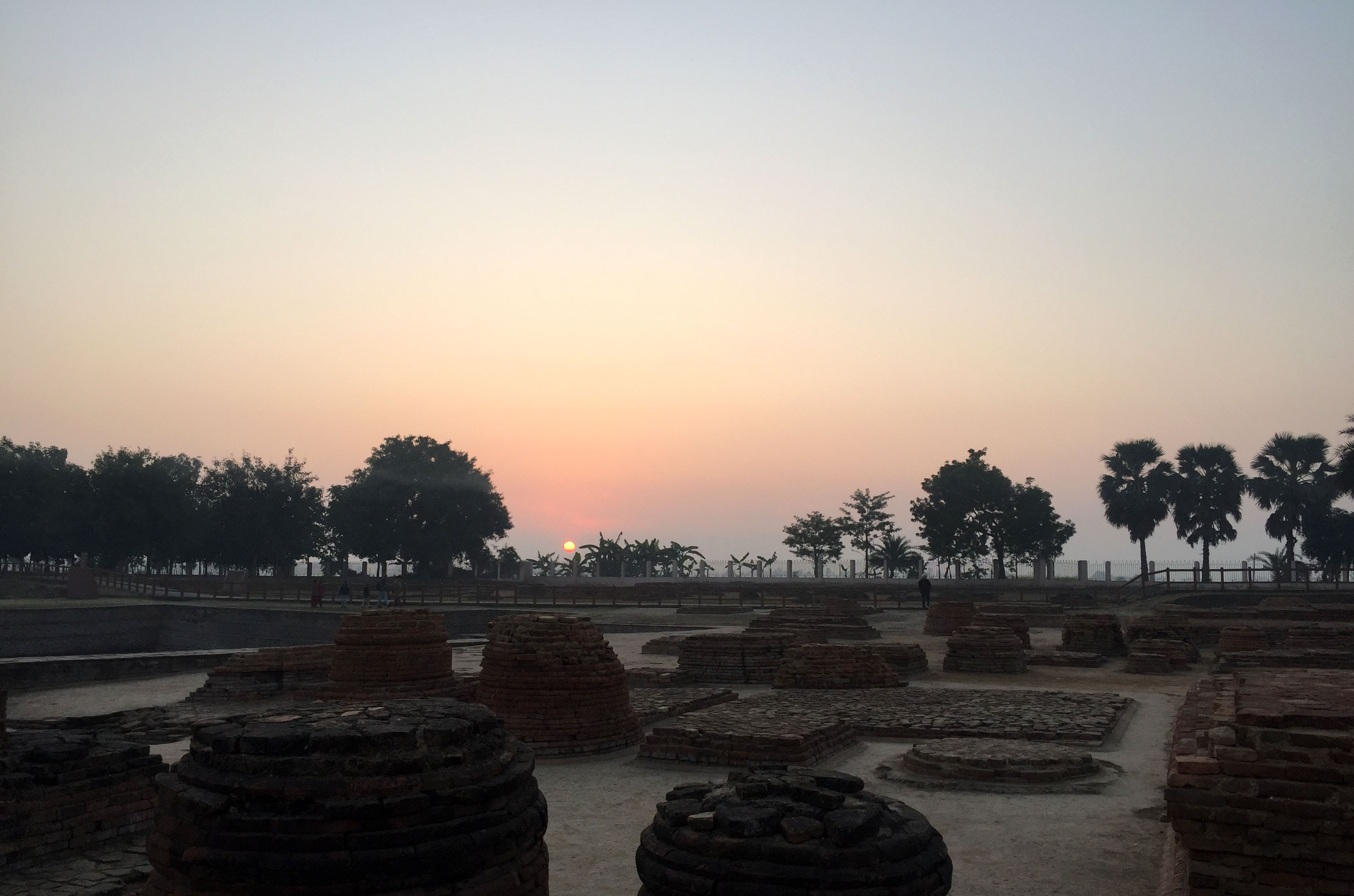
Photo by Ven. Changzhai
The Āgamas’ analysis of dependent origination is almost like an anatomical map of life. From consciousness conditioning name-and-form, to contact, feeling, craving, clinging, becoming, and ultimately birth, aging, sickness, and death, the so-called “self” does not inherently exist; it is continuously produced under the conditions of ignorance and craving. Fashi explained this repeatedly through different formulations—whether ten links, twelve links, seven links, or five links—they all point to the same reality: consciousness does not transcend name-and-form, and life cannot be established apart from consciousness. Craving is the fuel that drives consciousness to grasp at name-and-form, enabling life to continue and samsara to persist.
Viewed within the language of modern science, this does not necessarily conflict. Quantum physics reveals that without coupling conditions, energy cannot manifest as particles; without observation, a system’s state does not become fixed. What Buddhism calls direct grasping is precisely the key condition that solidifies a flowing process into “me.” The world is not inherently this way; rather, through craving and ignorance, we repeatedly seize it as “my world.”
Thus, practice is no longer abstract or idealistic, but extremely concrete. Fashi pointed out that the focal point of awareness lies in the present moment. At the point of contact, awareness can bring the quickest liberation, but it is also the most difficult. Intercepting at the stage of feeling means seeing clearly how craving arises between pursuing pleasure and avoiding pain. If one has already reached clinging, it is often only possible to remedy afterward. Practicing the four foundations of mindfulness and the six paramitas is not merely about accumulating merit, but about cultivating the capacity to know things as they truly are—not mistaking processes for entities, nor feelings for a self.
By the end of the lecture, a clear realization gradually emerged within me: the Āgamas do not promise a distant salvation; they point to a direction that can be changed immediately, right now. Because of impermanence, life is not predetermined. Because of non-self, suffering is not inevitable. Because of dependent origination, everything has room for adjustment.
In this era of rapid change and informational turbulence, perhaps what we lack is not knowledge, but the courage to trace back to the root. Perhaps what truly shocks in the Āgamas is not merely their explanation of the structure of samsara, but the clarity with which they allow us to see: for so many years, we have simply been dragged along—by emotions, by habits, by “this is me, that is mine.” We have rushed about endlessly, rarely pausing to ask: at this very moment, what is my mind doing?
When Guo Goang Fashi repeatedly brought us back to the immediacy of “consciousness conditioning name-and-form,” the impact did not come from mysticism, but from an almost stark clarity: life has never wronged us; we have simply never truly looked at it as it is. Suffering is not a punishment imposed by the world, but the repeated result of ignorance and craving. And the way out is not elsewhere—it is in each moment of seeing clearly, in each moment of no longer rushing to grasp.

Photo by pexels-frostroomhead
Practice is not about escaping the human world, but about choosing not to follow blindly each time contact, feeling, and craving are about to unfold. When consciousness temporarily ceases to cling to name-and-form, when the mind no longer rushes to prove “who I am,” samsara does not collapse with a crash, but it quietly loosens.
Perhaps ultimate peace is not a life without storms, but a heart that, amidst the storms, is no longer dragged away. In that moment, no labels are needed, no identity is required, not even a “self.” What remains is clarity, stillness, and a freedom never before recognized.
If this Āgama lecture has left me with anything, it is perhaps this confidence: awakening is not a distant ideal, but the courage and practice of being willing to see things as they are, beginning now. And this courage will not end with the lecture. In the coming weeks, there will be another eight hours of classes, continuing a deeper study of the Āgamas. May we be willing to transform this understanding into genuine effort—while listening, not rushing to comprehend; while reflecting, not rushing to conclude; while practicing, not rushing to change. May we again and again bring the mind back to the present, see dependent origination clearly, take the self lightly, and steady this restless heart.
Practice need not be earth-shattering. The current of birth and death may gradually come to rest precisely in these moment-by-moment turnings back.
— ✦ —
Cover photo by DDMBALA
Editor’s Note
Holly Li, a volunteer with the Dharma Drum Mountain Los Angeles Center, participated in a lecture by Venerable Guo Goang on the Āgamas on January 10–11, 2026. The author shares profound insights gathered from the teachings. Moving beyond abstract theory, the piece explores the early Buddhist scriptures as a practical, almost scientific framework for understanding the mechanics of suffering and liberation. Edited by Edward Lin.
— ✦ —
From January 10 to 11, 2026, listening to Venerable Guo Goang (Fashi) teach the Āgama scriptures was a learning process of being continuously “brought back to the roots.” If one does not understand the Āgamas, it is difficult to understand the Mahāyāna. This is not about elevating the early teachings, but a reminder: if one does not understand the most fundamental principles and logic of Buddhist practice, even the grandest theories may remain mere conceptual excitement, unable to truly transform life.
The Āgama scriptures are regarded as among the earliest teachings precisely because they do not go in circles or indulge in lyrical expression. They speak of principles, methods, and discernment, with only one aim—ultimate peace and happiness. “Ultimate” does not mean temporary emotional relief, but a stable fruit of liberation that does not fluctuate with conditions. Yet the fruit does not arise on its own; it requires the complete presence of causes and conditions. This clear causality and logical precision give the Āgamas an almost scientific spirit of rationality.
During the teaching, Fashi continually distinguished between “principle” and “phenomena.” Principle refers to unchanging, universally applicable truths. Phenomena refer to methods of practice established according to different people and times. This resonates deeply with traditional Chinese thought. The distinction in the I Ching between the Dao and its instruments expresses the same idea. The Dao does not change with individuals, but the instruments must be adapted to them. The eighty-four thousand Dharma doors are not chaotic; they are applications of the same principle in different states of life. The core that runs through them is dependent origination and non-self, and its concentrated expressions are the twelve links of dependent origination and the four noble truths.
What I found myself repeatedly reflecting on was Fashi’s emphasis on the elements of awakening: urgency and wise attention. Urgency is not a craving for mystical experiences, but a deep desire to understand the truth of life—a determination no longer to live superficially. In Confucianism, this is called setting one’s resolve. Without this aspiration, practice remains at the level of interest. Wise attention, on the other hand, is the training of the mind—a capacity to reexamine experience at its root. In adversity, instead of sinking into “Why me?”, one observes impermanence as it is. When criticized, instead of rushing to defend the self, one sees how anger arises through causes and conditions. Once anger is seen, it no longer holds dominant power. The reason we are constantly carried away by circumstances is not that the external world is too strong, but that ignorance is too deep.
Photo by Ven. Changzhai
The Āgamas’ analysis of dependent origination is almost like an anatomical map of life. From consciousness conditioning name-and-form, to contact, feeling, craving, clinging, becoming, and ultimately birth, aging, sickness, and death, the so-called “self” does not inherently exist; it is continuously produced under the conditions of ignorance and craving. Fashi explained this repeatedly through different formulations—whether ten links, twelve links, seven links, or five links—they all point to the same reality: consciousness does not transcend name-and-form, and life cannot be established apart from consciousness. Craving is the fuel that drives consciousness to grasp at name-and-form, enabling life to continue and samsara to persist.
Viewed within the language of modern science, this does not necessarily conflict. Quantum physics reveals that without coupling conditions, energy cannot manifest as particles; without observation, a system’s state does not become fixed. What Buddhism calls direct grasping is precisely the key condition that solidifies a flowing process into “me.” The world is not inherently this way; rather, through craving and ignorance, we repeatedly seize it as “my world.”
Thus, practice is no longer abstract or idealistic, but extremely concrete. Fashi pointed out that the focal point of awareness lies in the present moment. At the point of contact, awareness can bring the quickest liberation, but it is also the most difficult. Intercepting at the stage of feeling means seeing clearly how craving arises between pursuing pleasure and avoiding pain. If one has already reached clinging, it is often only possible to remedy afterward. Practicing the four foundations of mindfulness and the six paramitas is not merely about accumulating merit, but about cultivating the capacity to know things as they truly are—not mistaking processes for entities, nor feelings for a self.
By the end of the lecture, a clear realization gradually emerged within me: the Āgamas do not promise a distant salvation; they point to a direction that can be changed immediately, right now. Because of impermanence, life is not predetermined. Because of non-self, suffering is not inevitable. Because of dependent origination, everything has room for adjustment.
In this era of rapid change and informational turbulence, perhaps what we lack is not knowledge, but the courage to trace back to the root. Perhaps what truly shocks in the Āgamas is not merely their explanation of the structure of samsara, but the clarity with which they allow us to see: for so many years, we have simply been dragged along—by emotions, by habits, by “this is me, that is mine.” We have rushed about endlessly, rarely pausing to ask: at this very moment, what is my mind doing?
When Guo Goang Fashi repeatedly brought us back to the immediacy of “consciousness conditioning name-and-form,” the impact did not come from mysticism, but from an almost stark clarity: life has never wronged us; we have simply never truly looked at it as it is. Suffering is not a punishment imposed by the world, but the repeated result of ignorance and craving. And the way out is not elsewhere—it is in each moment of seeing clearly, in each moment of no longer rushing to grasp.
Photo by pexels-frostroomhead
Practice is not about escaping the human world, but about choosing not to follow blindly each time contact, feeling, and craving are about to unfold. When consciousness temporarily ceases to cling to name-and-form, when the mind no longer rushes to prove “who I am,” samsara does not collapse with a crash, but it quietly loosens.
Perhaps ultimate peace is not a life without storms, but a heart that, amidst the storms, is no longer dragged away. In that moment, no labels are needed, no identity is required, not even a “self.” What remains is clarity, stillness, and a freedom never before recognized.
If this Āgama lecture has left me with anything, it is perhaps this confidence: awakening is not a distant ideal, but the courage and practice of being willing to see things as they are, beginning now. And this courage will not end with the lecture. In the coming weeks, there will be another eight hours of classes, continuing a deeper study of the Āgamas. May we be willing to transform this understanding into genuine effort—while listening, not rushing to comprehend; while reflecting, not rushing to conclude; while practicing, not rushing to change. May we again and again bring the mind back to the present, see dependent origination clearly, take the self lightly, and steady this restless heart.
Practice need not be earth-shattering. The current of birth and death may gradually come to rest precisely in these moment-by-moment turnings back.
— ✦ —
Cover photo by DDMBALA
Get Chan Magazine sent to your inbox
Once quarterly
Please check your mailbox to confirm your subscription after clicking Subscribe.
Get Chan Magazine sent to your inbox
Once quarterly
Please check your mailbox to confirm your subscription after clicking Subscribe.