teachings
The Original Face
The Original Face
The Original Face
by Venerable Guo Huei
by Venerable Guo Huei
Editor's Note
Venerable Guo Huei, a Dharma heir of the late Chan Master Sheng Yen, currently serves as the sixth Abbot President of Dharma Drum Mountain in Taiwan. A scholar and practitioner, he holds a PhD in Literature from Rissho University in Japan and teaches at Dharma Drum Sangha University. This article is taken from the first-day Dharma talk from an intermediate Śamatha-Vipaśyanā retreat given by Ven. Guo Huei at the Dharma Drum Mountain Los Angeles Center on December 22, 2019. The venerable guides participants through the stages of Chan meditation—scattered mind, concentration, unification, and no-mind—toward realizing the “original face.” Drawing from personal experience and the Mahāyāna spirit of benefiting others, he presents Chan as both a method of inner transformation and a compassionate vow to serve all beings. Translated by Venerable Changzhai and edited by Venerable Changhwa and Edward Lin.
— ✦ —
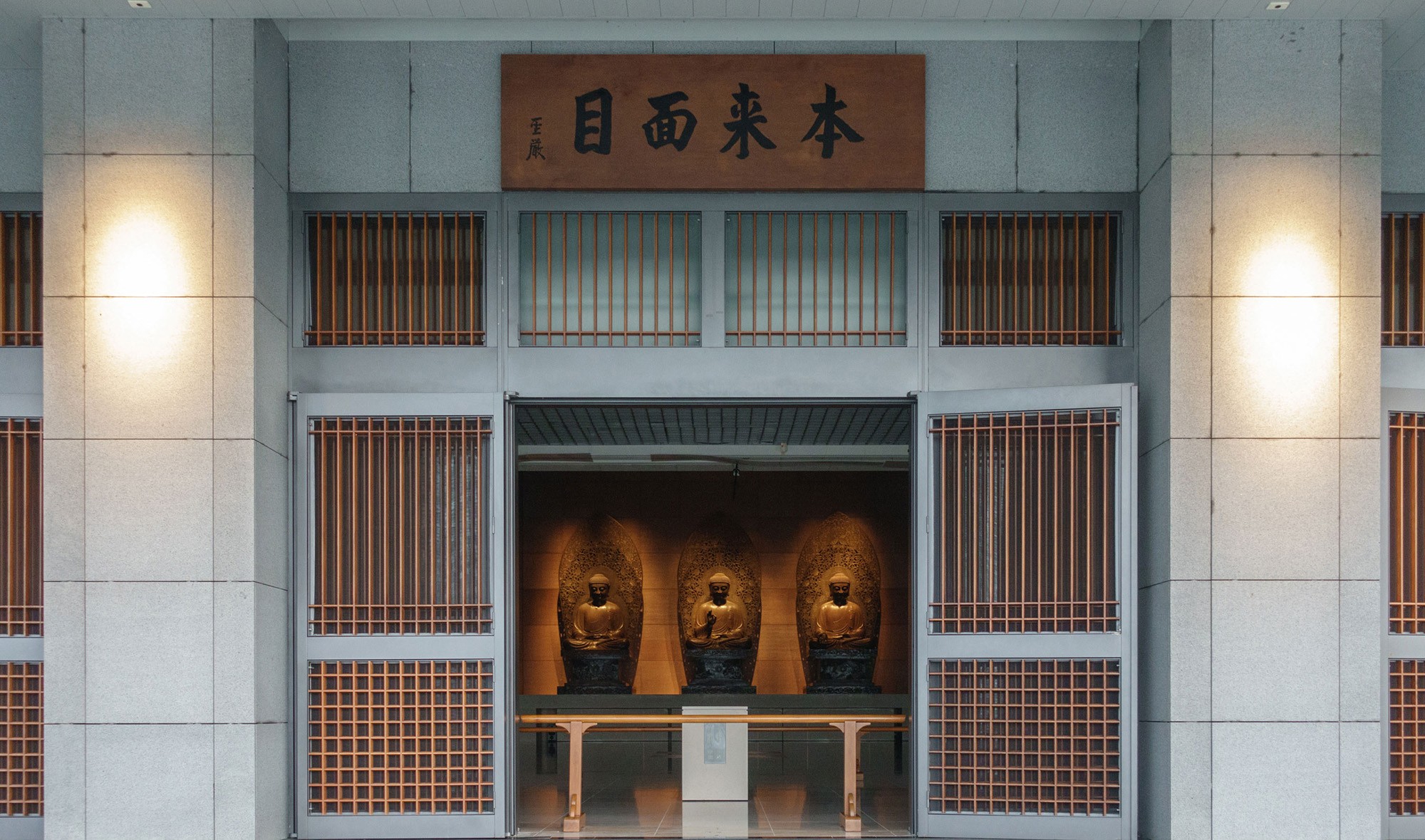
Above the main entrance of the Grand Hall at the Dharma Drum Mountain headquarters hangs a plaque inscribed with the four Chinese characters “本來面目” (“Original Face”). Do you believe everyone has their original face?
Every one of us has our “original face,” but we have not yet seen it. Only through the practice of the Buddhadharma can we “see” this original face, and meditation (Chan) is one of the methods. Chan practice enables the scattered mind to get concentrated and unified, and eventually even the unified mind needs to be let go of — reaching the state of no-mind. With no-mind, one can see the “original face.” This process may happen quickly—in this very life—or progress slowly, over several lives. Regardless, through continual practice we will have the opportunity to see our original face. The Platform Sutra calls this “knowing one’s own mind” and “seeing one’s own nature.”
Developing Aspiring Bodhicitta
Chan practice emphasizes training the mind. In Mahāyāna Buddhism, before training the mind, one must first develop aspiring bodhicitta. We know that “Enlightenment” means realizing the wisdom of no-self. Knowing this, we can start letting go of self-centered attachments even before awakening. By developing aspiring bodhicitta, we cultivate benefiting others to benefit ourselves—ultimately benefiting others without expecting anything in return. This is the best way to release self-attachment. Through benefiting others, compassion naturally arises. Only when self-attachment is released can wisdom unfold.
Thus, in Mahāyāna Chan, the wisdom of no-self is revealed by benefiting others, and the function of benefiting others is fulfilled through the wisdom of no-self. Cultivating wisdom itself is merely a process; compassion and the act of benefiting others are the ultimate goal, referred to as “adorning the lands and guiding all beings.” This is also the guiding spirit of Dharma Drum Mountain: “Uplift the character of humanity and build a pure land on earth.”
A Chan practitioner should make the vow: “I learn and practice Chan for seeking wisdom solely to benefit others.” If one practices only for oneself, the sense of “I” remains. Since Chan is the wisdom of no-self, what “I” is there to receive benefit? Therefore, one must develop aspiring bodhicitta, just as Master Sheng Yen taught: “Dedication is the practice; peace of mind is the accomplishment.” Only then can Chan practice become powerful.
We must also cultivate a sense of shame and remorse, as well as gratitude. The sense of shame and remorse arises when we realize we have not practiced well or have violated the rules—then we repent. Gratitude arises because we are grateful to be able to hear the Dharma and practice Chan. Every sitting session should be approached with a heart of gratitude and joy.
Photo by Dong Yang Li 李東陽
Cultivating the Six Pāramitās Altogether
Chan practice primarily employs the dhyāna pāramitā (the perfection of meditation), but in fact, during a seven-day retreat, all six perfections—generosity, morality, patience, diligence, meditation, and wisdom—are fully cultivated.
For instance, by devoting seven days and nights to this retreat, you are practicing generosity. The monastics and volunteers who support the retreat are also practicing generosity by offering their time, energy, and service. Most importantly, there is the giving of the Dharma: each day we also listen to Shifu Master Sheng Yen’s recorded teachings. Though his physical form is no longer with us, his teachings remain to guide and inspire us. This is akin to how the teachings of the Buddha and great patriarchs of past generations continue to be transmitted through the ages, guiding people to this day.
Some practitioners overlook the importance of observing morality (śīla). The retreat’s regulations and rules that all need to follow, which were introduced this afternoon after everyone entered the meditation hall — are, in essence, the practice of morality. Additionally, during the retreat, each sitting session lasts about forty minutes. From the second or third day, some may begin experiencing leg pain. When pain arises, there are methods to deal with it, and it's still essential to relax both your body and mind, rather than merely gritting your teeth and enduring the pain. If the pain persists, encourage yourself to persevere—this is an opportunity to practice patience (kṣānti). Each day, as we follow the retreat schedule, persevering through each sitting period and each day with diligence, we are cultivating the practice of diligence (vīrya). Listening to the Master’s teachings each day, we cultivate wisdom (prajñā). Though Chan practice centers on meditation, in essence it encompasses the cultivation of all SixPāramitās.

Photo by pexels-griffinw
My First Spiritual Experience
My participation in this retreat stems from several suggestions I've received since becoming the Abbot President of DDM, including Venerable Chi Chern. I am grateful for their reminders, which has afforded me the opportunity to practice alongside everyone and grow together. During this retreat, I have a daily session of Dharma sharing so we can encourage and learn from one another.
My path to monastic life began with a spiritual experience during my college years. Before graduation, my classmates organized a dance party at the Miramar Hotel. I had little interest in dancing and was in no mood for it. Back then, National Taiwan University (NTU) graduates either studied abroad, pursued further studies at NTU, or entered the workforce—each heading toward their own future. I, however, felt utterly lost about my future path. With no desire to dance, I sat alone outside the ballroom, and I recalled reading the story of Princess Miaoshan, the Avalokiteśvara Bodhisattva, attaining enlightenment. I knew I could chant the Bodhisattva's name, so I began silently reciting the name of Avalokiteśvara. Time passed unnoticed, and before I knew it, the party had ended.
After the party, on the bus ride home with a classmate, I continued silently reciting the Bodhisattva’s name. As we passed along Roosevelt Road, I was still reciting when an unprecedented experience suddenly occurred: I was chanting Guanyin Bodhisattva's name, yet I didn't see her. But I felt my body vanish, the bus disappear, and even the spatial sensation of the bus moving dissolve.
I was shocked by this sudden experience and burst into tears. After the crying subsided, I found that the name of the Bodhisattva disappeared. Then, an extremely subtle thought of the Bodhisattva’s name emerged, gradually the thought became coarse until the name was uttered from my mouth once again. After this experience, I knew my life path would not be to study abroad or find a job, but to leave home and cultivate the Way.
Although this experience from chanting Bodhisattva’s name to the state of thoughts disappeared, body sensations disappeared, and even time and space disappeared was not an enlightenment, it gave me deep faith in practice. I share this experience in the hope to encourage everyone. Whether through reciting the Buddha’s name or experiencing the breath, all these methods can collect our scattered mind to become focused and concentrated, to unify our mind, and eventually to reach the state of no-mind, from which to see our original face.
Intensive Retreat and Daily Practice
In earlier years, I participated in many seven-day Chan retreats led by Master Sheng Yen. Looking back, I often found myself watching self-acting-conducting movies. Things that had happened before the retreat—things I hadn't even thought about—would all come flooding back once I sat down to meditate. This is a scattered mind, not applying the method diligently, but instead watching a self-conducting movie.
Once, during a Self-Transcendence Chan Camp 自我超越營 we hosted, a participant happily shared that he had suddenly remembered someone owing him three hundred dollars. He was so proud of himself about this “realization.” In truth, this was a case of losing more than gaining. In this meditation hall supported by countless devotees, it took him three days to only earn back those three hundred dollars — a truly unprofitable exchange! Those who recognize the value of practice, are willing to practice, and have the time to do so, are truly rare among the rare. We are all immensely blessed. Please cherish this precious opportunity and practice diligently during the seven-day retreat.
An intensive meditation retreat primarily offers training that includes practicing methods and clarifying concepts. More importantly, it teaches how to apply the concepts and methods learned during the retreat to daily life. To use an analogy, an intensive retreat is like fast charging a phone, while daily practice, on the other hand, is like trickle charging. Both are essential and should not be neglected. After an intensive retreat, maintaining daily practice like a steady trickle will steadily enhance the strength of your practice. But if you neglect daily practice, only to recharge again when entering retreat, it can hardly be called “sustained endurance.”
Since the retreat has already begun, there's no need to dwell on whether you’ve practiced before. Let go of the past before the retreat and focus single-mindedly on practice in this very moment. Keep your mind present, wherever and whenever you are—that is most important.
Photo by DDM archives
The First Sitting
Buddhism offers many methods of practice; meditation is one of them, and it does not necessarily require sitting in formal posture. My earlier experience of losing track of time and space while chanting the Bodhisattva's name occurred while standing on a bus. Sitting meditation is merely foundational training—the key lies in correct and clear understanding of the Dharma. Throughout history, Chan patriarchs attained enlightenment not primarily through sitting meditation but often in daily life. For example, Chan Master Xu Yun (Empty Cloud) attained enlightenment during a tea break in a meditation retreat.
The principle of Chan practice is to use methods to transform the scattered mind into a concentrated mind, then into a unified mind, and finally into no-mind. A unified mind is one-mind, which has several levels: unification of body and mind, unification of inside and outside, and unification of thought-to-thought. Unification of thought-to-thought signifies entering deeper meditative absorption. In Chinese Chan practice, achieving the basic level of unification of body and mind is enough to cultivate wisdom, while it’s not necessary to achieve the unification of thought-to-thought to do so.
Throughout the meditation process, regulating the mind remains paramount, but it must begin with regulating the body. In ordinary life, our minds command our bodies. Our minds control our bodies to achieve unification. Chan practice is the opposite, which uses the body to unify the mind. The prerequisite is to relax both body and mind to the stage of “regulating the body.” Therefore, at the beginning of a retreat, we must undergo a certain degree of adjustment, allowing our usually tense body and mind to get fully relaxed, softened, and balanced. Only then can we have the opportunity to make progress toward the unification of body and mind.
Before coming to a seven-day retreat, most of you have likely been experiencing tension, fatigue, and stress in your work or family life. Once you enter the meditation hall, you need to gradually release that tension and fatigue so that your body becomes relaxed and naturally balanced—only then can you effectively apply the meditation method.
This process of relaxation and balancing is what the Tiantai text Xiao Zhiguan (An abbreviation for Essentials of Practicing Śamatha and Vipaśyanā Meditation)” calls the “The Five Regulations”: regulations of diet, sleep, body, breath, and mind. The basics lie in regulation of diet and sleep. During the retreat, the kitchen will well prepare the meals, so there is no need to worry about that. The only guidelines you need to keep in mind is that: “Eat neither too little nor too much.” If you eat too little, you may lack energy for meditation; if you eat too much, you may become drowsy while sitting.
Next comes regulation of sleep. At home, you might have your own room, but during the retreat you’ll likely share a room with others. What situations might arise? The most common issue is being disturbed by someone’s snoring—or realizing your own snoring disturbs others. Regardless of the situation, every retreat sees participants reporting disrupted sleep because of snoring.
When you encounter such disturbances, you learn to face them and accept them. You may find it hard at first, but gradually you will get used to it and ignore it, then let go of it. If sleep still eludes you, you may go to the meditation hall and do prostrations or sitting meditation. But you should not spend the entire night doing so. Otherwise, this would disrupt your circadian rhythm: you may feel fine practicing at night but find yourself drowsy during the day—a trade-off that isn't worth it.
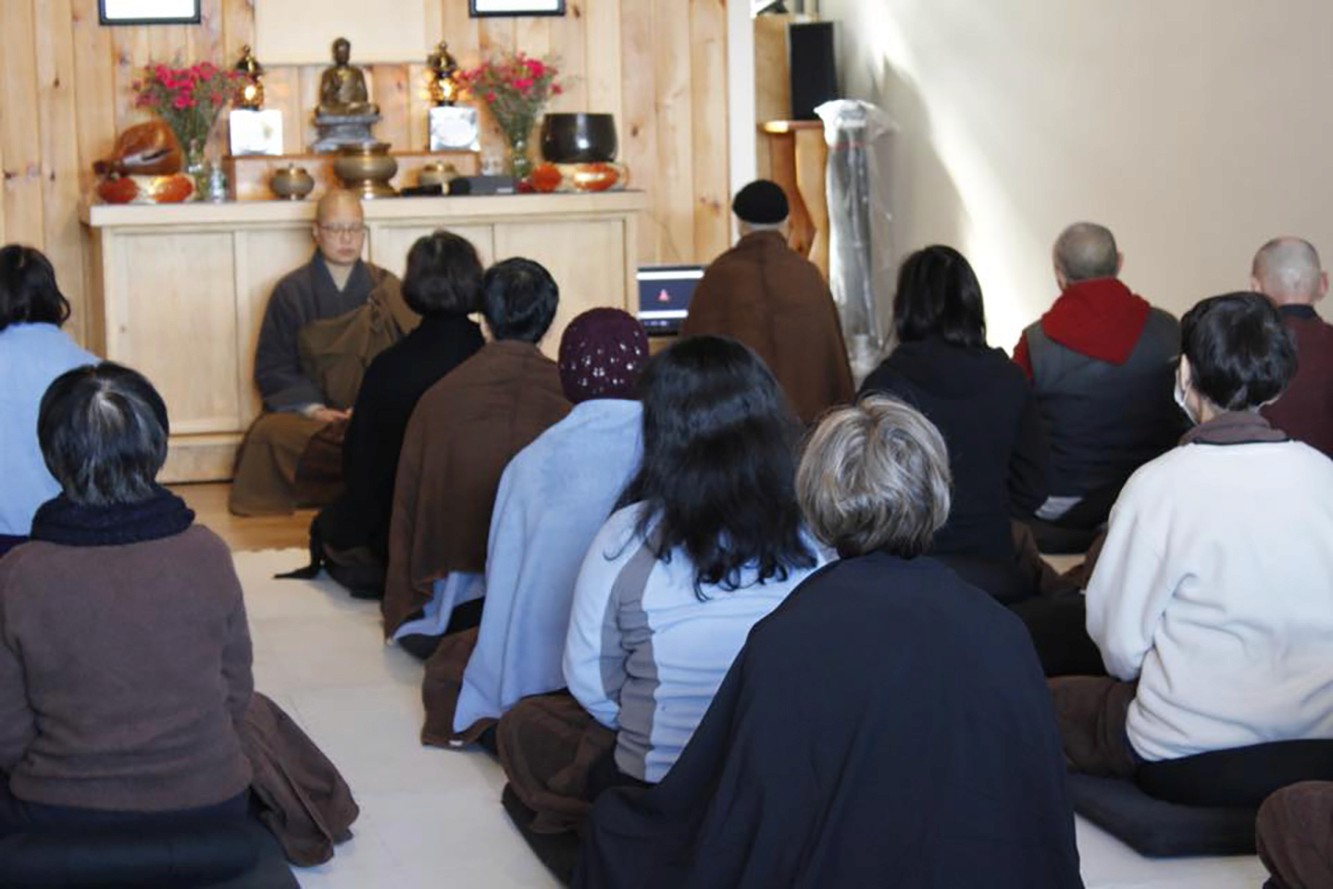
Photo by Chan Meditation Center
Everyone on this retreat has attended at least three retreats before, so you should be able to adapt quickly to the retreat schedule. However, each retreat is different, so you must let go of all your past experiences and treat this retreat as your first one. The same applies to sitting meditation—treat every sitting session as your first ever, each sitting as your first ever meditation since birth; treat every moment of practice as your first practice. Practicing in this manner is optimal and most conducive to applying the method.
When you are practicing, do not think of Buddhist theories—do not think about concepts like “emptiness,” “no-self,” or “enlightenment.” Do not imagine things like, “Is my current state about to enter a unified mind?” or “Is this the stage of lightness and ease?”—these are all delusions and false notions. The only thing to do is to relax the body and mind, and practice the method—again and again, tirelessly and persistently. Furthermore, don’t compare yourself with the past—not with the previous sitting period, nor with yesterday’s practice. Collect all thoughts and focus single-mindedly and wholeheartedly on the present moment. In this way, you can receive the benefits of meditation.
We have so many venerables and practitioners practicing together. The benefits of meditation are also collective—each person not only gains benefits from their own practice but also from the collective effort of the group. However, while sitting, do not think about others meditating with you. Instead, you must isolate yourself. Isolate yourself from time—past and future—and from space—inside and outside. Aside from the present moment, let go of everything else. In this way, the mind naturally moves from scatteredness to concentration, to unification, and may even have the possibility to reach no-mind. But do not imagine, “Now I’ve progressed from scattered mind to concentrated mind,” or “I’m entering a unified mind,” or “I’m about to reach no-mind”—those are still deluded thoughts. The meditation progression from a scattered mind to a concentrated mind, then to an unified mind, and ultimately to no-mind, is a natural process. It cannot be achieved through intended imagination, controlling, or seeking.
You can, however, make aspirations before each sitting, such as: “May I keep my body still for this entire session,” or “May I have no wandering thoughts or drowsiness, and practice the method single-mindedly.” Yet while practicing the method, refrain from describing, imagining, or seeking any state—those are deluded thoughts that have already strayed you from the method.
The Three Dharma Seals
There are three guidelines for Buddha’s teachings and Buddhist views: impermanence, no-self and nirvana— “All conditioned phenomena are impermanent; all dharmas have no independent self; nirvāṇa is absolute tranquil.”
These are known as the Three Dharma Seals 三法印. Impermanence means all phenomena are in a state of constant arising and perishing. Ordinary people, unaware of impermanence, cling to the notion of a permanent, unchanging self. This attachment leads to constant conflict with their own body and mind, their environment, and others, and further generates various afflictions and suffering. In our practice, we experience the constant flux of thoughts—this is impermanence. Ever-changing impermanence is the normal state of the mind. Therefore, experiencing wandering thoughts is normal. There is no need to confront wondering thoughts, nor should one dislike them. Just merely practice the method. This is the fundamental attitude of Chan practice.
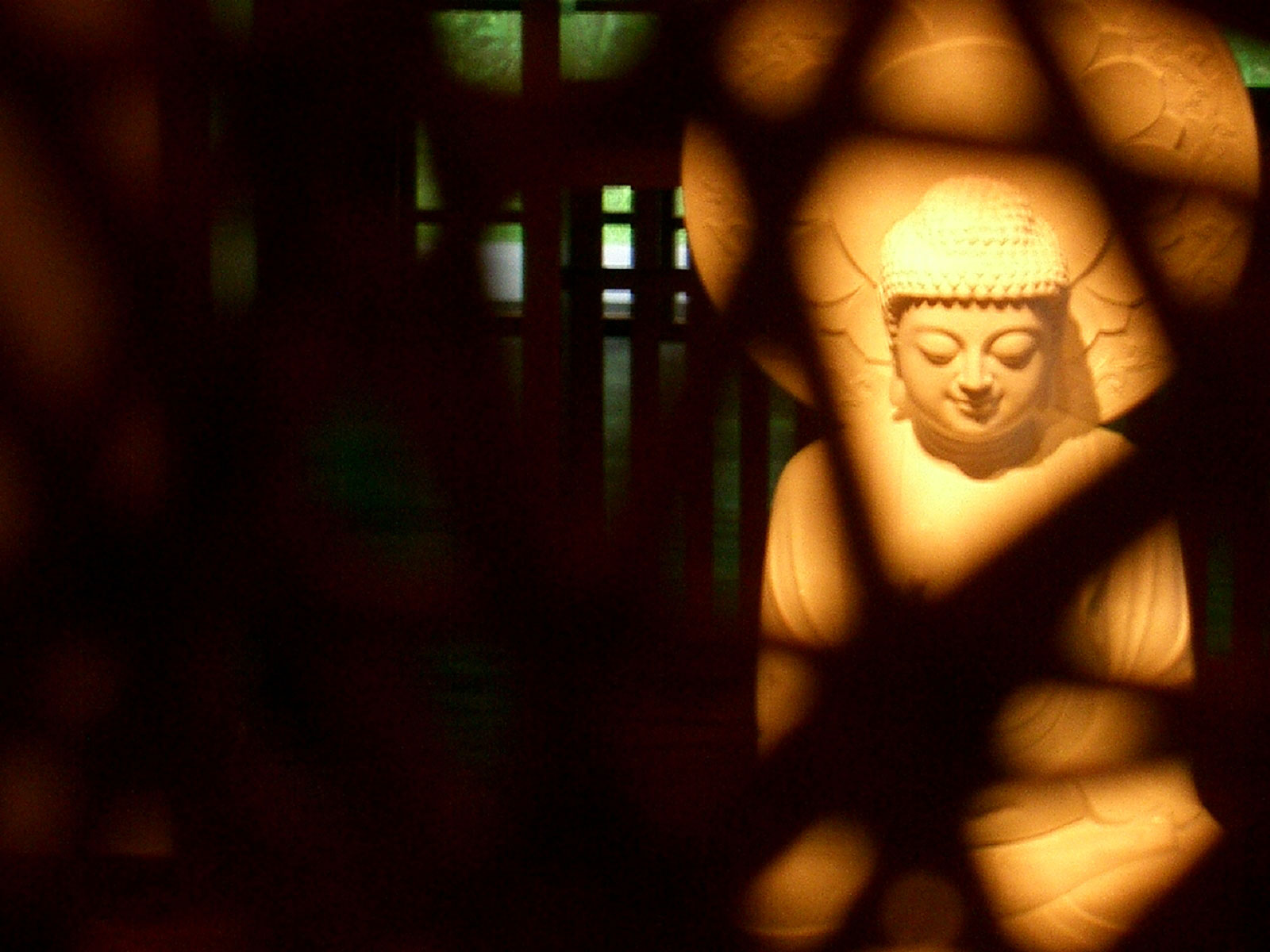
The Buddha statue in the Chan Hall of DDM Headquarter. Photo by Wen Ling Li 李文玲.
At Dharma Drum Mountain, the Chan system progresses from foundational methods such as Recitation of the Buddha’s Name 念佛 or Counting the Breath 數息, to intermediate practices like Calming-and-Insight (Śamatha and Vipaśyanā) 止觀 or Recitation Chan of the Buddha’s Name 念佛禪, and finally to advanced practices such as Huatou 話頭 or Silent Illumination 默照. Both Silent Illumination and Huatou follow systematic stages and methods of cultivation.
This retreat is an intermediate-level Calming-and-Insight Retreat. We do not teach counting or following the breath here, but if you cannot apply the method of Calming-and-Insight, you may return to the method of counting or following the breath. The practice of Śamatha-Vipaśyanā initially employs contemplation to settle the mind, using contemplation to achieve stillness of the mind—this is the fundamental principle of cultivating Śamatha-Vipaśyanā. However, this stage of contemplation is not yet true contemplative wisdom (insight); true wisdom reveals during the transition from unified mind to no-mind.
The contemplation before reaching the unified mind is the contemplation that leads to samādhi (concentration). If one can practice the method and technique well, attaining the unified mind is not difficult. From the unified mind to no-mind rely on contemplative wisdom. This part is more difficult, as it requires a clear and thorough understanding of the Three Dharma Seals—impermanence, non-self, and nirvana—combined with proper application of the methods.
Although meditation is a process that progresses from a scattered mind, to a concentrated mind, to a unified mind, and finally to no-mind, before we even begin from the scattered mind, we must clearly understand the principles of contemplative wisdom.
The principles of contemplative wisdom are expressed in the Three Dharma Seals: “All conditioned things are impermanent; all dharmas have no independent self; nirvāṇa is absolute tranquil,” or alternatively, “impermanence, no-self, emptiness.” Although the terms differ, their essence is identical.
Impermanence refers to the outward appearance, but if we look deeply into the nature of impermanence, we see it is in fact no-self—that is, emptiness. When we truly perceive the mark of impermanence, we can dissolve various attachments to the self and all afflictions.
Every thought that arises is a manifestation of impermanence, which is scattered and chaotic. The purpose of practice is to gather and transform this chaotic, random impermanence into a regulated, ordered impermanence, and then to unify it into a state of “fixed consistency.” The transition from impermanence to “fixed consistency” is the unification of the mind. When entering the state of unified mind:
‧ If the body and mind are unified, the sensation of the body disappears.
‧ If the body, mind, and environment are unified, the sense of space disappears.
‧ If thought-to-thought becomes unified, both the sense of time and space vanish.
However, none of these states are enlightenment; at most, they are levels associated with samādhi (meditative concentration). Meditative concentration may yield experiences of time and space vanishing, but these are not yet the realization of wisdom (prajñā).
One must employ the methods of Chan—either the Huatou or Silent Illumination—to truly shatter the “one-mind” and reach the “no-mind”, thereby corresponding to the wisdom of no-self.
-- First Day Lecture of the Intermediate Śamatha-Vipaśyanā Retreat, December 22, 2019
Reference: Venerable Guo Huei, The Chan Practices of Zhi and Guan: A Key to Opening Up Our Spiritual Mind (Taipei, Dharma Drum Corp. 2021), p. 13-25
Editor's Note
Venerable Guo Huei, a Dharma heir of the late Chan Master Sheng Yen, currently serves as the sixth Abbot President of Dharma Drum Mountain in Taiwan. A scholar and practitioner, he holds a PhD in Literature from Rissho University in Japan and teaches at Dharma Drum Sangha University. This article is taken from the first-day Dharma talk from an intermediate Śamatha-Vipaśyanā retreat given by Ven. Guo Huei at the Dharma Drum Mountain Los Angeles Center on December 22, 2019. The venerable guides participants through the stages of Chan meditation—scattered mind, concentration, unification, and no-mind—toward realizing the “original face.” Drawing from personal experience and the Mahāyāna spirit of benefiting others, he presents Chan as both a method of inner transformation and a compassionate vow to serve all beings. Translated by Venerable Changzhai and edited by Venerable Changhwa and Edward Lin.
— ✦ —
Above the main entrance of the Grand Hall at the Dharma Drum Mountain headquarters hangs a plaque inscribed with the four Chinese characters “本來面目” (“Original Face”). Do you believe everyone has their original face?
Every one of us has our “original face,” but we have not yet seen it. Only through the practice of the Buddhadharma can we “see” this original face, and meditation (Chan) is one of the methods. Chan practice enables the scattered mind to get concentrated and unified, and eventually even the unified mind needs to be let go of — reaching the state of no-mind. With no-mind, one can see the “original face.” This process may happen quickly—in this very life—or progress slowly, over several lives. Regardless, through continual practice we will have the opportunity to see our original face. The Platform Sutra calls this “knowing one’s own mind” and “seeing one’s own nature.”
Developing Aspiring Bodhicitta
Chan practice emphasizes training the mind. In Mahāyāna Buddhism, before training the mind, one must first develop aspiring bodhicitta. We know that “Enlightenment” means realizing the wisdom of no-self. Knowing this, we can start letting go of self-centered attachments even before awakening. By developing aspiring bodhicitta, we cultivate benefiting others to benefit ourselves—ultimately benefiting others without expecting anything in return. This is the best way to release self-attachment. Through benefiting others, compassion naturally arises. Only when self-attachment is released can wisdom unfold.
Thus, in Mahāyāna Chan, the wisdom of no-self is revealed by benefiting others, and the function of benefiting others is fulfilled through the wisdom of no-self. Cultivating wisdom itself is merely a process; compassion and the act of benefiting others are the ultimate goal, referred to as “adorning the lands and guiding all beings.” This is also the guiding spirit of Dharma Drum Mountain: “Uplift the character of humanity and build a pure land on earth.”
A Chan practitioner should make the vow: “I learn and practice Chan for seeking wisdom solely to benefit others.” If one practices only for oneself, the sense of “I” remains. Since Chan is the wisdom of no-self, what “I” is there to receive benefit? Therefore, one must develop aspiring bodhicitta, just as Master Sheng Yen taught: “Dedication is the practice; peace of mind is the accomplishment.” Only then can Chan practice become powerful.
We must also cultivate a sense of shame and remorse, as well as gratitude. The sense of shame and remorse arises when we realize we have not practiced well or have violated the rules—then we repent. Gratitude arises because we are grateful to be able to hear the Dharma and practice Chan. Every sitting session should be approached with a heart of gratitude and joy.
Photo by Dong Yang Li 李東陽
Cultivating the Six Pāramitās Altogether
Chan practice primarily employs the dhyāna pāramitā (the perfection of meditation), but in fact, during a seven-day retreat, all six perfections—generosity, morality, patience, diligence, meditation, and wisdom—are fully cultivated.
For instance, by devoting seven days and nights to this retreat, you are practicing generosity. The monastics and volunteers who support the retreat are also practicing generosity by offering their time, energy, and service. Most importantly, there is the giving of the Dharma: each day we also listen to Shifu Master Sheng Yen’s recorded teachings. Though his physical form is no longer with us, his teachings remain to guide and inspire us. This is akin to how the teachings of the Buddha and great patriarchs of past generations continue to be transmitted through the ages, guiding people to this day.
Some practitioners overlook the importance of observing morality (śīla). The retreat’s regulations and rules that all need to follow, which were introduced this afternoon after everyone entered the meditation hall — are, in essence, the practice of morality. Additionally, during the retreat, each sitting session lasts about forty minutes. From the second or third day, some may begin experiencing leg pain. When pain arises, there are methods to deal with it, and it's still essential to relax both your body and mind, rather than merely gritting your teeth and enduring the pain. If the pain persists, encourage yourself to persevere—this is an opportunity to practice patience (kṣānti). Each day, as we follow the retreat schedule, persevering through each sitting period and each day with diligence, we are cultivating the practice of diligence (vīrya). Listening to the Master’s teachings each day, we cultivate wisdom (prajñā). Though Chan practice centers on meditation, in essence it encompasses the cultivation of all SixPāramitās.
Photo by pexels-griffinw
My First Spiritual Experience
My participation in this retreat stems from several suggestions I've received since becoming the Abbot President of DDM, including Venerable Chi Chern. I am grateful for their reminders, which has afforded me the opportunity to practice alongside everyone and grow together. During this retreat, I have a daily session of Dharma sharing so we can encourage and learn from one another.
My path to monastic life began with a spiritual experience during my college years. Before graduation, my classmates organized a dance party at the Miramar Hotel. I had little interest in dancing and was in no mood for it. Back then, National Taiwan University (NTU) graduates either studied abroad, pursued further studies at NTU, or entered the workforce—each heading toward their own future. I, however, felt utterly lost about my future path. With no desire to dance, I sat alone outside the ballroom, and I recalled reading the story of Princess Miaoshan, the Avalokiteśvara Bodhisattva, attaining enlightenment. I knew I could chant the Bodhisattva's name, so I began silently reciting the name of Avalokiteśvara. Time passed unnoticed, and before I knew it, the party had ended.
After the party, on the bus ride home with a classmate, I continued silently reciting the Bodhisattva’s name. As we passed along Roosevelt Road, I was still reciting when an unprecedented experience suddenly occurred: I was chanting Guanyin Bodhisattva's name, yet I didn't see her. But I felt my body vanish, the bus disappear, and even the spatial sensation of the bus moving dissolve.
I was shocked by this sudden experience and burst into tears. After the crying subsided, I found that the name of the Bodhisattva disappeared. Then, an extremely subtle thought of the Bodhisattva’s name emerged, gradually the thought became coarse until the name was uttered from my mouth once again. After this experience, I knew my life path would not be to study abroad or find a job, but to leave home and cultivate the Way.
Although this experience from chanting Bodhisattva’s name to the state of thoughts disappeared, body sensations disappeared, and even time and space disappeared was not an enlightenment, it gave me deep faith in practice. I share this experience in the hope to encourage everyone. Whether through reciting the Buddha’s name or experiencing the breath, all these methods can collect our scattered mind to become focused and concentrated, to unify our mind, and eventually to reach the state of no-mind, from which to see our original face.
Intensive Retreat and Daily Practice
In earlier years, I participated in many seven-day Chan retreats led by Master Sheng Yen. Looking back, I often found myself watching self-acting-conducting movies. Things that had happened before the retreat—things I hadn't even thought about—would all come flooding back once I sat down to meditate. This is a scattered mind, not applying the method diligently, but instead watching a self-conducting movie.
Once, during a Self-Transcendence Chan Camp 自我超越營 we hosted, a participant happily shared that he had suddenly remembered someone owing him three hundred dollars. He was so proud of himself about this “realization.” In truth, this was a case of losing more than gaining. In this meditation hall supported by countless devotees, it took him three days to only earn back those three hundred dollars — a truly unprofitable exchange! Those who recognize the value of practice, are willing to practice, and have the time to do so, are truly rare among the rare. We are all immensely blessed. Please cherish this precious opportunity and practice diligently during the seven-day retreat.
An intensive meditation retreat primarily offers training that includes practicing methods and clarifying concepts. More importantly, it teaches how to apply the concepts and methods learned during the retreat to daily life. To use an analogy, an intensive retreat is like fast charging a phone, while daily practice, on the other hand, is like trickle charging. Both are essential and should not be neglected. After an intensive retreat, maintaining daily practice like a steady trickle will steadily enhance the strength of your practice. But if you neglect daily practice, only to recharge again when entering retreat, it can hardly be called “sustained endurance.”
Since the retreat has already begun, there's no need to dwell on whether you’ve practiced before. Let go of the past before the retreat and focus single-mindedly on practice in this very moment. Keep your mind present, wherever and whenever you are—that is most important.
Photo by DDM archives
The First Sitting
Buddhism offers many methods of practice; meditation is one of them, and it does not necessarily require sitting in formal posture. My earlier experience of losing track of time and space while chanting the Bodhisattva's name occurred while standing on a bus. Sitting meditation is merely foundational training—the key lies in correct and clear understanding of the Dharma. Throughout history, Chan patriarchs attained enlightenment not primarily through sitting meditation but often in daily life. For example, Chan Master Xu Yun (Empty Cloud) attained enlightenment during a tea break in a meditation retreat.
The principle of Chan practice is to use methods to transform the scattered mind into a concentrated mind, then into a unified mind, and finally into no-mind. A unified mind is one-mind, which has several levels: unification of body and mind, unification of inside and outside, and unification of thought-to-thought. Unification of thought-to-thought signifies entering deeper meditative absorption. In Chinese Chan practice, achieving the basic level of unification of body and mind is enough to cultivate wisdom, while it’s not necessary to achieve the unification of thought-to-thought to do so.
Throughout the meditation process, regulating the mind remains paramount, but it must begin with regulating the body. In ordinary life, our minds command our bodies. Our minds control our bodies to achieve unification. Chan practice is the opposite, which uses the body to unify the mind. The prerequisite is to relax both body and mind to the stage of “regulating the body.” Therefore, at the beginning of a retreat, we must undergo a certain degree of adjustment, allowing our usually tense body and mind to get fully relaxed, softened, and balanced. Only then can we have the opportunity to make progress toward the unification of body and mind.
Before coming to a seven-day retreat, most of you have likely been experiencing tension, fatigue, and stress in your work or family life. Once you enter the meditation hall, you need to gradually release that tension and fatigue so that your body becomes relaxed and naturally balanced—only then can you effectively apply the meditation method.
This process of relaxation and balancing is what the Tiantai text Xiao Zhiguan (An abbreviation for Essentials of Practicing Śamatha and Vipaśyanā Meditation)” calls the “The Five Regulations”: regulations of diet, sleep, body, breath, and mind. The basics lie in regulation of diet and sleep. During the retreat, the kitchen will well prepare the meals, so there is no need to worry about that. The only guidelines you need to keep in mind is that: “Eat neither too little nor too much.” If you eat too little, you may lack energy for meditation; if you eat too much, you may become drowsy while sitting.
Next comes regulation of sleep. At home, you might have your own room, but during the retreat you’ll likely share a room with others. What situations might arise? The most common issue is being disturbed by someone’s snoring—or realizing your own snoring disturbs others. Regardless of the situation, every retreat sees participants reporting disrupted sleep because of snoring.
When you encounter such disturbances, you learn to face them and accept them. You may find it hard at first, but gradually you will get used to it and ignore it, then let go of it. If sleep still eludes you, you may go to the meditation hall and do prostrations or sitting meditation. But you should not spend the entire night doing so. Otherwise, this would disrupt your circadian rhythm: you may feel fine practicing at night but find yourself drowsy during the day—a trade-off that isn't worth it.
Photo by Chan Meditation Center
Everyone on this retreat has attended at least three retreats before, so you should be able to adapt quickly to the retreat schedule. However, each retreat is different, so you must let go of all your past experiences and treat this retreat as your first one. The same applies to sitting meditation—treat every sitting session as your first ever, each sitting as your first ever meditation since birth; treat every moment of practice as your first practice. Practicing in this manner is optimal and most conducive to applying the method.
When you are practicing, do not think of Buddhist theories—do not think about concepts like “emptiness,” “no-self,” or “enlightenment.” Do not imagine things like, “Is my current state about to enter a unified mind?” or “Is this the stage of lightness and ease?”—these are all delusions and false notions. The only thing to do is to relax the body and mind, and practice the method—again and again, tirelessly and persistently. Furthermore, don’t compare yourself with the past—not with the previous sitting period, nor with yesterday’s practice. Collect all thoughts and focus single-mindedly and wholeheartedly on the present moment. In this way, you can receive the benefits of meditation.
We have so many venerables and practitioners practicing together. The benefits of meditation are also collective—each person not only gains benefits from their own practice but also from the collective effort of the group. However, while sitting, do not think about others meditating with you. Instead, you must isolate yourself. Isolate yourself from time—past and future—and from space—inside and outside. Aside from the present moment, let go of everything else. In this way, the mind naturally moves from scatteredness to concentration, to unification, and may even have the possibility to reach no-mind. But do not imagine, “Now I’ve progressed from scattered mind to concentrated mind,” or “I’m entering a unified mind,” or “I’m about to reach no-mind”—those are still deluded thoughts. The meditation progression from a scattered mind to a concentrated mind, then to an unified mind, and ultimately to no-mind, is a natural process. It cannot be achieved through intended imagination, controlling, or seeking.
You can, however, make aspirations before each sitting, such as: “May I keep my body still for this entire session,” or “May I have no wandering thoughts or drowsiness, and practice the method single-mindedly.” Yet while practicing the method, refrain from describing, imagining, or seeking any state—those are deluded thoughts that have already strayed you from the method.
The Three Dharma Seals
There are three guidelines for Buddha’s teachings and Buddhist views: impermanence, no-self and nirvana— “All conditioned phenomena are impermanent; all dharmas have no independent self; nirvāṇa is absolute tranquil.”
These are known as the Three Dharma Seals 三法印. Impermanence means all phenomena are in a state of constant arising and perishing. Ordinary people, unaware of impermanence, cling to the notion of a permanent, unchanging self. This attachment leads to constant conflict with their own body and mind, their environment, and others, and further generates various afflictions and suffering. In our practice, we experience the constant flux of thoughts—this is impermanence. Ever-changing impermanence is the normal state of the mind. Therefore, experiencing wandering thoughts is normal. There is no need to confront wondering thoughts, nor should one dislike them. Just merely practice the method. This is the fundamental attitude of Chan practice.
The Buddha statue in the Chan Hall of DDM Headquarter. Photo by Wen Ling Li 李文玲.
At Dharma Drum Mountain, the Chan system progresses from foundational methods such as Recitation of the Buddha’s Name 念佛 or Counting the Breath 數息, to intermediate practices like Calming-and-Insight (Śamatha and Vipaśyanā) 止觀 or Recitation Chan of the Buddha’s Name 念佛禪, and finally to advanced practices such as Huatou 話頭 or Silent Illumination 默照. Both Silent Illumination and Huatou follow systematic stages and methods of cultivation.
This retreat is an intermediate-level Calming-and-Insight Retreat. We do not teach counting or following the breath here, but if you cannot apply the method of Calming-and-Insight, you may return to the method of counting or following the breath. The practice of Śamatha-Vipaśyanā initially employs contemplation to settle the mind, using contemplation to achieve stillness of the mind—this is the fundamental principle of cultivating Śamatha-Vipaśyanā. However, this stage of contemplation is not yet true contemplative wisdom (insight); true wisdom reveals during the transition from unified mind to no-mind.
The contemplation before reaching the unified mind is the contemplation that leads to samādhi (concentration). If one can practice the method and technique well, attaining the unified mind is not difficult. From the unified mind to no-mind rely on contemplative wisdom. This part is more difficult, as it requires a clear and thorough understanding of the Three Dharma Seals—impermanence, non-self, and nirvana—combined with proper application of the methods.
Although meditation is a process that progresses from a scattered mind, to a concentrated mind, to a unified mind, and finally to no-mind, before we even begin from the scattered mind, we must clearly understand the principles of contemplative wisdom.
The principles of contemplative wisdom are expressed in the Three Dharma Seals: “All conditioned things are impermanent; all dharmas have no independent self; nirvāṇa is absolute tranquil,” or alternatively, “impermanence, no-self, emptiness.” Although the terms differ, their essence is identical.
Impermanence refers to the outward appearance, but if we look deeply into the nature of impermanence, we see it is in fact no-self—that is, emptiness. When we truly perceive the mark of impermanence, we can dissolve various attachments to the self and all afflictions.
Every thought that arises is a manifestation of impermanence, which is scattered and chaotic. The purpose of practice is to gather and transform this chaotic, random impermanence into a regulated, ordered impermanence, and then to unify it into a state of “fixed consistency.” The transition from impermanence to “fixed consistency” is the unification of the mind. When entering the state of unified mind:
‧ If the body and mind are unified, the sensation of the body disappears.
‧ If the body, mind, and environment are unified, the sense of space disappears.
‧ If thought-to-thought becomes unified, both the sense of time and space vanish.
However, none of these states are enlightenment; at most, they are levels associated with samādhi (meditative concentration). Meditative concentration may yield experiences of time and space vanishing, but these are not yet the realization of wisdom (prajñā).
One must employ the methods of Chan—either the Huatou or Silent Illumination—to truly shatter the “one-mind” and reach the “no-mind”, thereby corresponding to the wisdom of no-self.
-- First Day Lecture of the Intermediate Śamatha-Vipaśyanā Retreat, December 22, 2019
Reference: Venerable Guo Huei, The Chan Practices of Zhi and Guan: A Key to Opening Up Our Spiritual Mind (Taipei, Dharma Drum Corp. 2021), p. 13-25
Get Chan Magazine sent to your inbox
Once quarterly
Please check your mailbox to confirm your subscription after clicking Subscribe.
Get Chan Magazine sent to your inbox
Once quarterly
Please check your mailbox to confirm your subscription after clicking Subscribe.