dialogue
A Dialogue Between Venerable Guo Goang and Žarko Andričević
A Dialogue Between Venerable Guo Goang and Žarko Andričević
A Dialogue Between Venerable Guo Goang and Žarko Andričević
by Venerable Guo Goang and Žarko Andričević
by Venerable Guo Goang and Žarko Andričević
Editor's Note
Venerable Guo Goang, a Dharma heir of Master Sheng Yen since 2005, became a bhikṣuṇī in 1990. From 2006 to 2013, she served as the provost of Dharma Drum Mountain (DDM), and from 2013 to 2019 she undertook a six-year solitary retreat. She currently serves as Vice Abbot of DDM and as a senior teacher at the Chan Meditation Center in Queens, New York.
Žarko Andričević is the founder of the Dharmaloka Chan Buddhist Community and Chan Retreat Center in Croatia. He first encountered Buddhism in 1975 and, in the mid-1980s, he started the first Buddhist study and meditation group in Croatia. A student of Chan Master Sheng Yen since 1996, he received Dharma transmission in 2001 and has since led retreats across Europe, North America, Taiwan, and Australia.
In a wide-ranging conversation held on Juy 7, 2025, the two longtime Dharma teachers reflect on the state of Chan in the West. Through personal stories, reflections on cultural adaptation, and insight into the role of Dharma teachers, this dialogue highlights the evolving yet rooted nature of Chan practice across continents and generations. Translated by Elise Yu and edited by Edward Lin.
— ✦ —
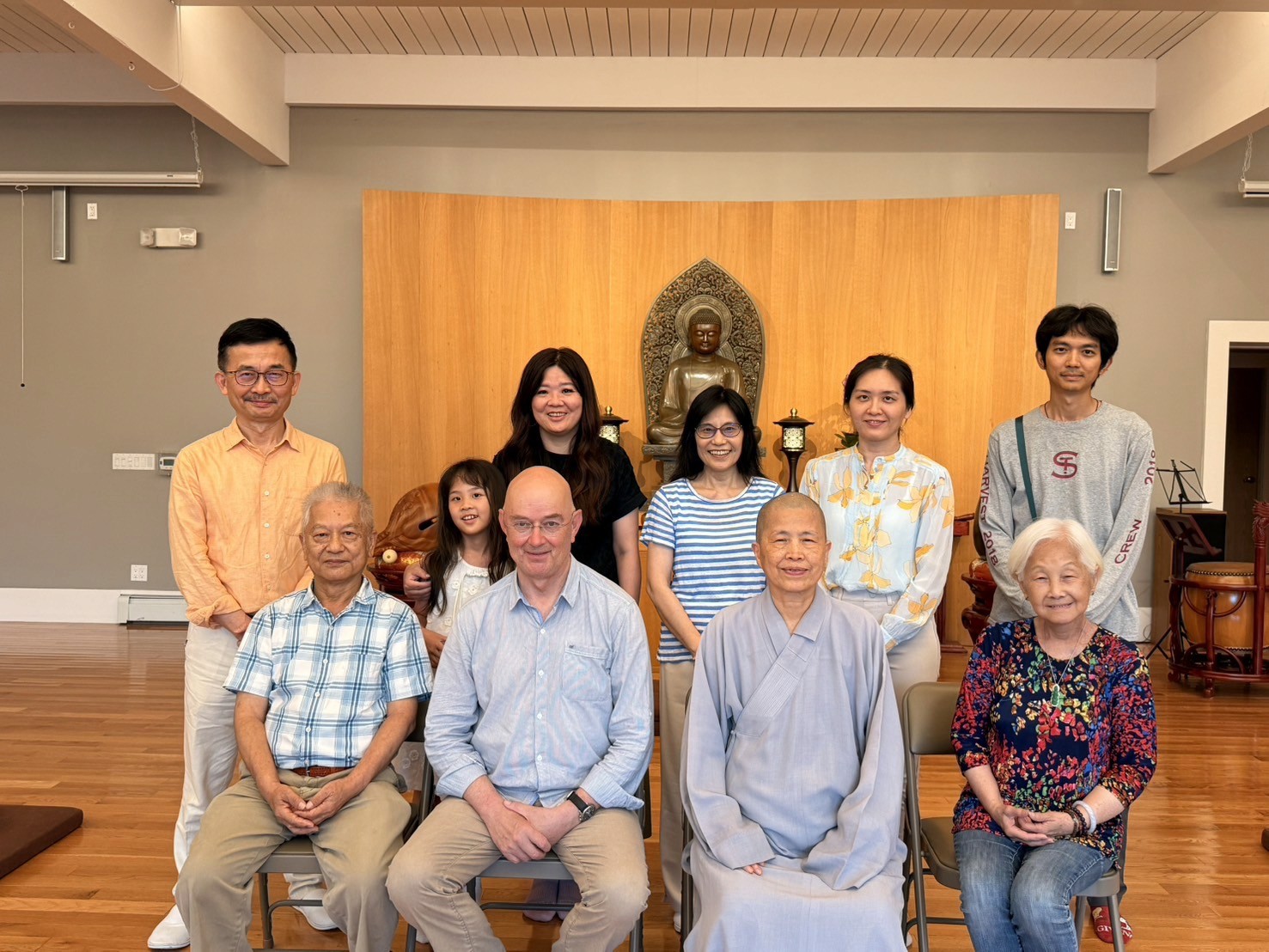
On July 7, 2025, after concluding his trip to New York, Žarko visited the Dharma Drum Mountain Buddhist Association New Jersey Chapter to meet with Ven. Guo Goang. I was honored to serve as the interpreter and had the privilege of listening to the profound dialogue between the two masters. Below is a summary of part of their conversations:
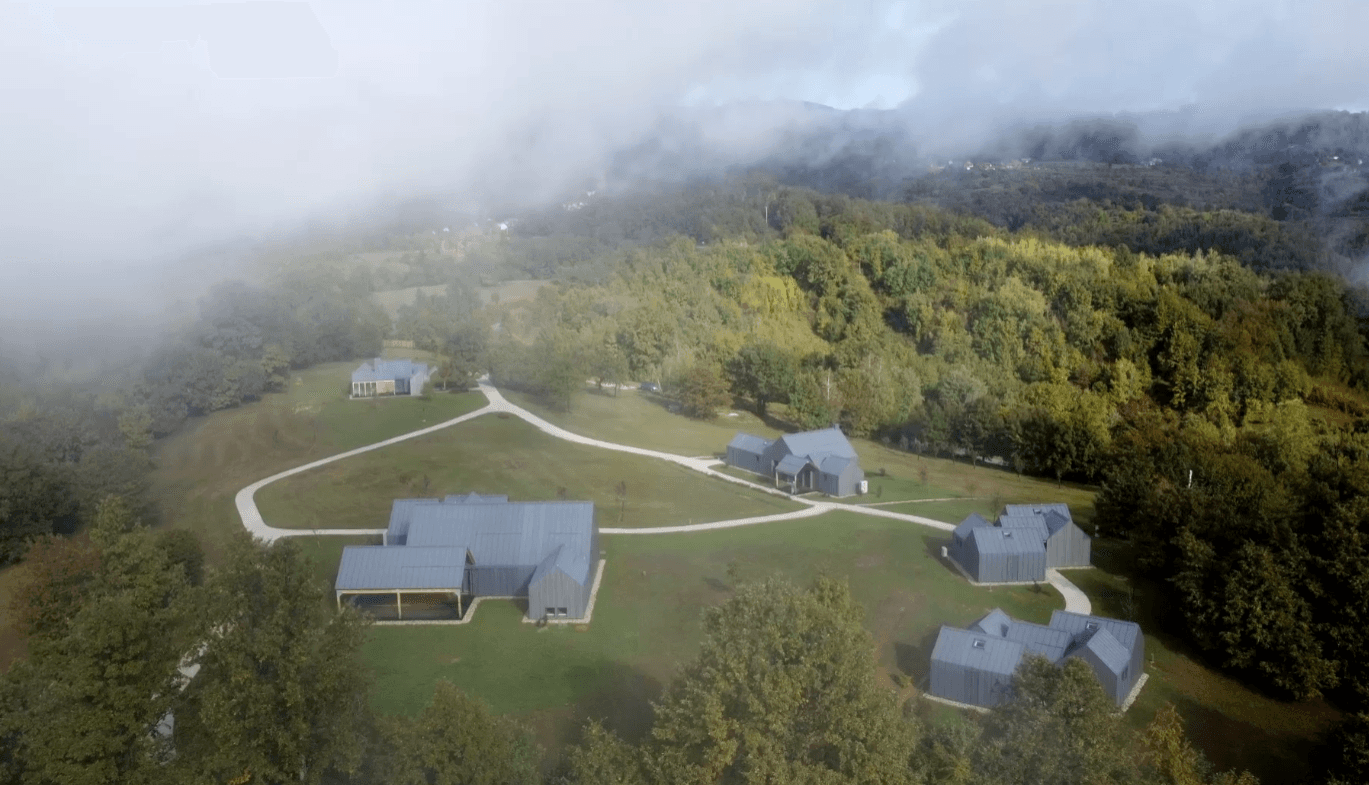
Chan Retreat Center Hartovski Vrh
After some greetings, Ven. Guo Goang asked Žarko about the Chan Center that they established in Croatia. Žarko shared that their Chan Center in Croatia has a history of over forty years. In the early days, the center operated in the capital city and in a rented space. Later, they established the new center in the mountainous area near the capital. The Chan Center offers teachings on the theory and meditation practice of Chan Buddhism, the primary practice method being Silent Illumination. Additionally, the center provides yoga classes and meditation workshops for families. Over the past four years, they have run a Dharma teacher training program, which has graduated fifteen Dharma teachers. When asked whether he had ever gone on a pilgrimage to India, Žarko said he had visited individually but had not yet led a group. He mentioned that about ten years ago, he traveled to China with fellow practitioners from Germany, the UK, and Croatia, and they visited many Chan temples on their way from Beijing to Shanghai. The practitioners from Croatia then continued to Taiwan, where they visited the Dharma Drum Mountain headquarters and stayed for five days. Žarko remarked that the architectural style of Dharma Drum Mountain reflects the character of Master Sheng Yen—elegant within modernity, and solemn within simplicity.
Pilgrimage to India
Ven. Guo Goang shared her experience in 2024, when she led practitioners in North America on a pilgrimage to India. During the journey, they arrived in Lumbini, Nepal—the birthplace of Shakyamuni Buddha. Ven. Guo Goang said she felt an unusual sense of familiarity upon arrival. The area is still undeveloped and has been preserved in its natural state. For example, the city gate through which the Buddha is said to have once passed on horseback still stands today. They later arrived at Bodhgaya, the site of the Buddha’s enlightenment. The Venerable mentioned that despite the many people chanting, prostrating, and meditating at the site, it did not feel noisy—probably because they all shared a common aspiration. After that, they visited Vulture Peak. According to the Lotus Sutra, while the Buddha was resting at the foot of the peak, Devadatta once attempted to harm him by pushing a boulder down from the summit. The Venerable said that when she herself climbed Vulture Peak, she could indeed see the platform below and “experience” the scene described in the sutra. On the way to Vulture Peak, many vendors were selling amala fruit. In the Śūraṅgama Sūtra, the Buddha said, “Looking at Jambudvipa with such clarity as he might an amala fruit in the palm of his hand.” (1) Therefore, people on the pilgrimage bought and tasted the fruit. Its flavor was quite unique.
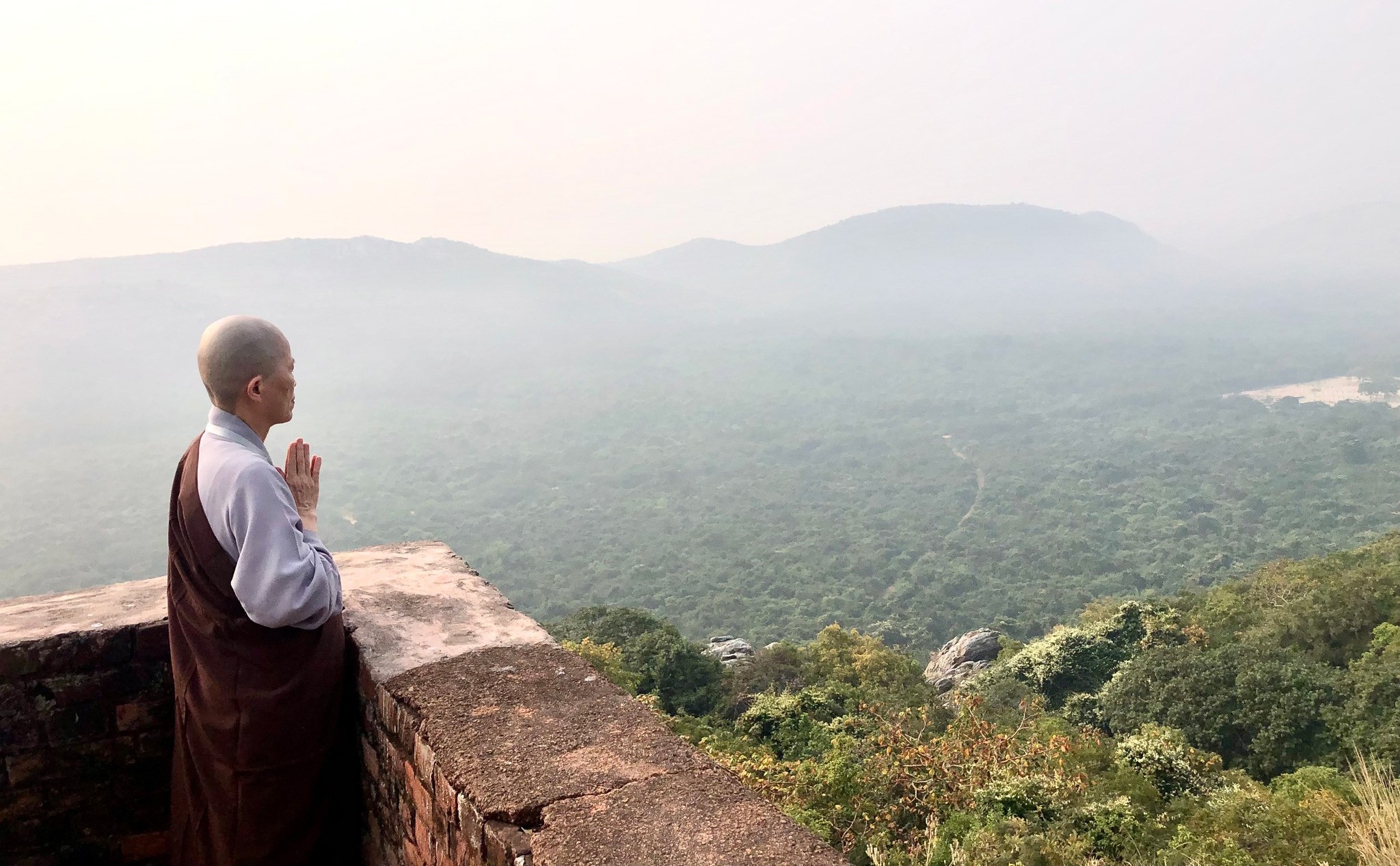
Photo by Chan Meditation Center
Ven. Guo Goang also spoke of their visit to the National Museum of India, which houses a collection of approximately fifteen pieces of Buddha's relics. She mentioned that three relics had fallen from the upper tier of the stupa and appeared not to have been promptly attended to. Perhaps because there were so many relics, they were not cherished. In contrast, despite having a very small number of relics, we treasure them deeply. The two masters then turned to a discussion about the similarities and differences between Hinduism and Buddhism. Ven. Guo Goang mentioned that during her pilgrimage, she visited Nalanda University and met a monastic from Dharma Drum Mountain who was studying there, along with a professor who teaches at the university. Ven. Guo Goang was told that the university offers a course on Madhyamaka Buddhism, but the instructor is a Hindu rather than a Buddhist, and many Indians believe Buddhism is a branch of Hinduism. She reflected that this is quite thought-provoking: Nalanda was originally a Buddhist temple—could it be that, as Madhyamaka and Yogācāra philosophies flourished, the emphasis on logical debate led it to gradually evolve into an academic institution? In the process did it absorb elements of Hinduism, causing the distinct characteristics of Buddhism to fade over time and eventually disappear from India altogether?
Ven. Guo Goang explained ancient Indians believed the winner of a debate was the one who possessed the truth, and that the loser should follow the victor. Žarko added that at a recent international Buddhist education conference, one keynote speaker gave a talk that sounded like Buddhism, but he frequently used terms like “soul,” which are rarely used in Buddhist teachings. Later, he found out that the speaker was not a Buddhist. Žarko noted that the modern world is more diverse and inclusive, unlike ancient India, where truth was sought primarily through debate. Of course, winning a debate does not necessarily mean possessing the truth. Ven. Guo Goang then quoted the Buddha’s teaching: when the Dharma gradually becomes confused with non-Buddhist philosophies to the point that the true Dharma is obscured, this obscured Dharma is called “semblance Dharma.” This marks the period of the Semblance Dharma Age. The emergence of semblance Dharma is the major reason for the gradual disappearance of the true Dharma. The Buddha admonished his disciples to keep this firmly in mind.
Causes and Conditions
A practitioner in the audience asked: “Why is ‘soul’ not a Buddhist term? And how does Buddhism differ from other belief systems?” Žarko explained that the concept of soul comes from Christianity, which posits that each person has an eternal and imperishable soul. Hinduism also has the concept of Ātman. Buddhism, however, does not recognize a permanent, unchanging, independently existing soul. In Buddhism, the closest concept to the soul is the self or self-attachment. Ordinary beings all have this self-attachment, and it is the root of all suffering. Yet this self is not an unchanging, permanent entity, but something that arises dependently from causes and conditions. Because of self-attachment, ordinary beings cling to the distinction between self and others, creating various conflicts and pressures in their efforts to protect and satisfy the self.
Žarko further pointed out that the eighth consciousness functions like a storehouse, accumulating all karmic seeds. For example, when we arrive in an unfamiliar place and smell a certain scent, the seeds stored in the eighth consciousness may surface, reminding us of similar past experiences—this is how memory operates. Everything we perceive is tainted by our own “colored glasses,” conditioned by our childhood, education, social environment, and many other factors. Everything we perceive is merely a manifestation of our mind; there is no such thing as a truly external object. The purpose of Buddhist practice is to transform this perspective of duality with a self into the wisdom of non-self. Ven. Guo Goang added that the main difference between Buddhism and non-Buddhist views is dependent origination. Buddhism teaches all phenomena are subject to arising and ceasing, whereas non-Buddhist traditions believe in the existence of eternal, unchanging entities. For example, Hinduism holds that there is a permanent self that continues to cycle through birth and death.
Another practitioner asked: “In Taiwan, some Buddhist groups also take part in the Mazu Pilgrimage to attract people to Buddhism. In a religiously diverse environment, how can we maintain our Buddhist beliefs?” Ven. Guo Goang responded that this can be understood on two levels. First, Mazu is a local folk belief, not a world religion. Mazu became revered as a sea goddess because of the moving life story of Lin Moniang, and fishermen who lived along the coast worshipped her because of her efficacious protection. But such beliefs emphasize faith more than theory or practice. Second, world religions such as Catholicism and Hinduism also have theory and practice, but their fundamental difference from Buddhism lies in their understanding of life and the origin of the world. Most other religions believe in a single creator, whereas Buddhism teaches everything arises because of dependent origination.
Žarko added that the simplest criteria for discerning the true Dharma are the Three Dharma Seals taught by the Buddha. Ven. Guo Goang also explained that other major religions claim the existence of a greater self or a Brahmā, but the Buddhist teachings of impermanence, non-self, and emptiness in the Three Dharma Seals are all based on the principle of dependent origination. What the Buddha realized under the Bodhi tree was precisely dependent origination: because all things arise because of causes and conditions, they are impermanent and without a self, which negates the concept of an eternal and unchanging self. If one can realize emptiness and non-self, one attains Nirvāṇa and transcends the three realms. However, if one continues to cling to the notion of a self, one cannot escape the cycle of birth and death within the three realms.
Another practitioner then asked: “Since everything arises from causes and conditions, if one creates unwholesome karma, can practice prevent the karmic causes and conditions from ripening, so that one does not experience suffering?” Žarko explained that within the Noble Eightfold Path, Right Action and Right Effort are meant to guide us to “refrain from all evil and cultivate all good.” If one maintains a positive and wholesome mindset, the seeds of unwholesome karma are less likely to sprout. Yet, practice is not merely about pursuing good; goodness itself is merely a supporting condition for practice, allowing the body and mind to settle and deepen our practice. The ultimate goal of practice is to transcend the duality of good and bad. Ven. Guo Goang added that there are two aspects to this matter. First, if a deed has already been carried out through body, speech, and mind, then its karmic result will inevitably manifest. Second, between creating karma and experiencing its consequences, one can lessen the impact of its results through practice and the accumulation of blessings. She gave an example from the sutras: if you put a spoonful of salt in a cup of water, it will be very salty and bitter. But if you put it in a large container and add more water, the saltiness will not be as noticeable. The salt represents the karmic result. Through practice, we can cultivate our wisdom and blessings to “dilute the saltiness.” Although the karmic result is still there, it will not be bitter.
Žarko added that while the karmic result will eventually manifest, we have the freedom to choose how we face and respond to it. If we simply react according to our habitual tendencies, we will only reinforce those habits. But if we respond with awareness, we can change our destiny. Buddhism is not fatalism. If that were the case, there would be no liberation. The Buddha himself once appeared to have a headache because of past karma, but he did not “suffer.” Causes and effects are intricate and do not follow a linear relationship. Time itself is only a relative illusion. For example, when we are tired, time feels slow, but during a good sitting, time seems to fly by.

Photo by pexels-eberhard-grossgasteiger
Admonition of Chan Practice
During dinner, Žarko shared some anecdotes about Master Sheng Yen’s trip to Croatia to lead a retreat. At that time, their center was just a rented house, and the meditation hall was a small room with limited capacity. Therefore, they asked the landlord if they could tear down a wall to create more space, and the landlord readily agreed. The kitchen in the house was also tiny, and the Master was amazed at how they cooked meals for twenty people there. One afternoon, everyone suddenly noticed that Master Sheng Yen had disappeared from the center. They were anxious and searched everywhere, worried that something might have happened. The area was remote, and the local residents had never seen an Asian person, let alone an Asian monk. After a while, the Master returned on his own, explaining that he had simply gone for a walk out of curiosity, and he said with a smile that the local people were very friendly.
Finally, Ven. Guo Goang and Žarko discussed the practice of Silent Illumination. Ven. Guo Goang spoke about Chan Master Hongzhi Zhengjue’s Admonition on Chan Practice, and explained how to cultivate the state of “knowing without encountering things, illumining without opposing conditions” through the method of xì niàn zài qián (繫念在前) “establishing the mindfulness in front.” By placing deep attention on the area between the tip of the nose and the upper lip, the mind becomes anchored in front. Where the attention is, the mind is. Through this deep attention, the mind becomes settled and still, and from that stillness, awareness naturally manifests. As this stillness deepens, the awareness gradually expands—from noticing the breath, to sensing the whole body, and to being aware of the environment. When the mind is anchored in front without directly engaging the object, this is “knowing without encountering things.” The initial stages of Silent Illumination include relaxing the body and mind, experiencing the breath, contemplating the totality of the body, and contemplating the environment. At these stages, one can use “establishing the mindfulness in front” to enter the practice. Ven. Guo Goang then asked Žarko about the second verse from the Admonition on Chan Practice: “Without encountering things, it knows—its knowing is inherently subtle. Not opposing conditions, it illumines—its luminosity is naturally wondrous.” How is it subtle? How is it wondrous? Žarko replied, “Just like this pair of chopsticks in my hand, it is a phenomenon arising from causes and conditions. There is no 'self' in this; all phenomena are like this.” Žarko was delighted to learn about the method of "establishing the mindfulness in front" and said he would try it.
I feel truly lucky to listen in on the conversation between these two masters. Their exchange was not only a conversation between them but also a precious teaching for everyone present. (I acknowledge any errors in this record, and I would greatly appreciate your thoughtful corrections.)
Editor's Note
Venerable Guo Goang, a Dharma heir of Master Sheng Yen since 2005, became a bhikṣuṇī in 1990. From 2006 to 2013, she served as the provost of Dharma Drum Mountain (DDM), and from 2013 to 2019 she undertook a six-year solitary retreat. She currently serves as Vice Abbot of DDM and as a senior teacher at the Chan Meditation Center in Queens, New York.
Žarko Andričević is the founder of the Dharmaloka Chan Buddhist Community and Chan Retreat Center in Croatia. He first encountered Buddhism in 1975 and, in the mid-1980s, he started the first Buddhist study and meditation group in Croatia. A student of Chan Master Sheng Yen since 1996, he received Dharma transmission in 2001 and has since led retreats across Europe, North America, Taiwan, and Australia.
In a wide-ranging conversation held on Juy 7, 2025, the two longtime Dharma teachers reflect on the state of Chan in the West. Through personal stories, reflections on cultural adaptation, and insight into the role of Dharma teachers, this dialogue highlights the evolving yet rooted nature of Chan practice across continents and generations. Translated by Elise Yu and edited by Edward Lin.
— ✦ —
On July 7, 2025, after concluding his trip to New York, Žarko visited the Dharma Drum Mountain Buddhist Association New Jersey Chapter to meet with Ven. Guo Goang. I was honored to serve as the interpreter and had the privilege of listening to the profound dialogue between the two masters. Below is a summary of part of their conversations:
Chan Retreat Center Hartovski Vrh
After some greetings, Ven. Guo Goang asked Žarko about the Chan Center that they established in Croatia. Žarko shared that their Chan Center in Croatia has a history of over forty years. In the early days, the center operated in the capital city and in a rented space. Later, they established the new center in the mountainous area near the capital. The Chan Center offers teachings on the theory and meditation practice of Chan Buddhism, the primary practice method being Silent Illumination. Additionally, the center provides yoga classes and meditation workshops for families. Over the past four years, they have run a Dharma teacher training program, which has graduated fifteen Dharma teachers. When asked whether he had ever gone on a pilgrimage to India, Žarko said he had visited individually but had not yet led a group. He mentioned that about ten years ago, he traveled to China with fellow practitioners from Germany, the UK, and Croatia, and they visited many Chan temples on their way from Beijing to Shanghai. The practitioners from Croatia then continued to Taiwan, where they visited the Dharma Drum Mountain headquarters and stayed for five days. Žarko remarked that the architectural style of Dharma Drum Mountain reflects the character of Master Sheng Yen—elegant within modernity, and solemn within simplicity.
Pilgrimage to India
Ven. Guo Goang shared her experience in 2024, when she led practitioners in North America on a pilgrimage to India. During the journey, they arrived in Lumbini, Nepal—the birthplace of Shakyamuni Buddha. Ven. Guo Goang said she felt an unusual sense of familiarity upon arrival. The area is still undeveloped and has been preserved in its natural state. For example, the city gate through which the Buddha is said to have once passed on horseback still stands today. They later arrived at Bodhgaya, the site of the Buddha’s enlightenment. The Venerable mentioned that despite the many people chanting, prostrating, and meditating at the site, it did not feel noisy—probably because they all shared a common aspiration. After that, they visited Vulture Peak. According to the Lotus Sutra, while the Buddha was resting at the foot of the peak, Devadatta once attempted to harm him by pushing a boulder down from the summit. The Venerable said that when she herself climbed Vulture Peak, she could indeed see the platform below and “experience” the scene described in the sutra. On the way to Vulture Peak, many vendors were selling amala fruit. In the Śūraṅgama Sūtra, the Buddha said, “Looking at Jambudvipa with such clarity as he might an amala fruit in the palm of his hand.” (1) Therefore, people on the pilgrimage bought and tasted the fruit. Its flavor was quite unique.
Photo by Chan Meditation Center
Ven. Guo Goang also spoke of their visit to the National Museum of India, which houses a collection of approximately fifteen pieces of Buddha's relics. She mentioned that three relics had fallen from the upper tier of the stupa and appeared not to have been promptly attended to. Perhaps because there were so many relics, they were not cherished. In contrast, despite having a very small number of relics, we treasure them deeply. The two masters then turned to a discussion about the similarities and differences between Hinduism and Buddhism. Ven. Guo Goang mentioned that during her pilgrimage, she visited Nalanda University and met a monastic from Dharma Drum Mountain who was studying there, along with a professor who teaches at the university. Ven. Guo Goang was told that the university offers a course on Madhyamaka Buddhism, but the instructor is a Hindu rather than a Buddhist, and many Indians believe Buddhism is a branch of Hinduism. She reflected that this is quite thought-provoking: Nalanda was originally a Buddhist temple—could it be that, as Madhyamaka and Yogācāra philosophies flourished, the emphasis on logical debate led it to gradually evolve into an academic institution? In the process did it absorb elements of Hinduism, causing the distinct characteristics of Buddhism to fade over time and eventually disappear from India altogether?
Ven. Guo Goang explained ancient Indians believed the winner of a debate was the one who possessed the truth, and that the loser should follow the victor. Žarko added that at a recent international Buddhist education conference, one keynote speaker gave a talk that sounded like Buddhism, but he frequently used terms like “soul,” which are rarely used in Buddhist teachings. Later, he found out that the speaker was not a Buddhist. Žarko noted that the modern world is more diverse and inclusive, unlike ancient India, where truth was sought primarily through debate. Of course, winning a debate does not necessarily mean possessing the truth. Ven. Guo Goang then quoted the Buddha’s teaching: when the Dharma gradually becomes confused with non-Buddhist philosophies to the point that the true Dharma is obscured, this obscured Dharma is called “semblance Dharma.” This marks the period of the Semblance Dharma Age. The emergence of semblance Dharma is the major reason for the gradual disappearance of the true Dharma. The Buddha admonished his disciples to keep this firmly in mind.
Causes and Conditions
A practitioner in the audience asked: “Why is ‘soul’ not a Buddhist term? And how does Buddhism differ from other belief systems?” Žarko explained that the concept of soul comes from Christianity, which posits that each person has an eternal and imperishable soul. Hinduism also has the concept of Ātman. Buddhism, however, does not recognize a permanent, unchanging, independently existing soul. In Buddhism, the closest concept to the soul is the self or self-attachment. Ordinary beings all have this self-attachment, and it is the root of all suffering. Yet this self is not an unchanging, permanent entity, but something that arises dependently from causes and conditions. Because of self-attachment, ordinary beings cling to the distinction between self and others, creating various conflicts and pressures in their efforts to protect and satisfy the self.
Žarko further pointed out that the eighth consciousness functions like a storehouse, accumulating all karmic seeds. For example, when we arrive in an unfamiliar place and smell a certain scent, the seeds stored in the eighth consciousness may surface, reminding us of similar past experiences—this is how memory operates. Everything we perceive is tainted by our own “colored glasses,” conditioned by our childhood, education, social environment, and many other factors. Everything we perceive is merely a manifestation of our mind; there is no such thing as a truly external object. The purpose of Buddhist practice is to transform this perspective of duality with a self into the wisdom of non-self. Ven. Guo Goang added that the main difference between Buddhism and non-Buddhist views is dependent origination. Buddhism teaches all phenomena are subject to arising and ceasing, whereas non-Buddhist traditions believe in the existence of eternal, unchanging entities. For example, Hinduism holds that there is a permanent self that continues to cycle through birth and death.
Another practitioner asked: “In Taiwan, some Buddhist groups also take part in the Mazu Pilgrimage to attract people to Buddhism. In a religiously diverse environment, how can we maintain our Buddhist beliefs?” Ven. Guo Goang responded that this can be understood on two levels. First, Mazu is a local folk belief, not a world religion. Mazu became revered as a sea goddess because of the moving life story of Lin Moniang, and fishermen who lived along the coast worshipped her because of her efficacious protection. But such beliefs emphasize faith more than theory or practice. Second, world religions such as Catholicism and Hinduism also have theory and practice, but their fundamental difference from Buddhism lies in their understanding of life and the origin of the world. Most other religions believe in a single creator, whereas Buddhism teaches everything arises because of dependent origination.
Žarko added that the simplest criteria for discerning the true Dharma are the Three Dharma Seals taught by the Buddha. Ven. Guo Goang also explained that other major religions claim the existence of a greater self or a Brahmā, but the Buddhist teachings of impermanence, non-self, and emptiness in the Three Dharma Seals are all based on the principle of dependent origination. What the Buddha realized under the Bodhi tree was precisely dependent origination: because all things arise because of causes and conditions, they are impermanent and without a self, which negates the concept of an eternal and unchanging self. If one can realize emptiness and non-self, one attains Nirvāṇa and transcends the three realms. However, if one continues to cling to the notion of a self, one cannot escape the cycle of birth and death within the three realms.
Another practitioner then asked: “Since everything arises from causes and conditions, if one creates unwholesome karma, can practice prevent the karmic causes and conditions from ripening, so that one does not experience suffering?” Žarko explained that within the Noble Eightfold Path, Right Action and Right Effort are meant to guide us to “refrain from all evil and cultivate all good.” If one maintains a positive and wholesome mindset, the seeds of unwholesome karma are less likely to sprout. Yet, practice is not merely about pursuing good; goodness itself is merely a supporting condition for practice, allowing the body and mind to settle and deepen our practice. The ultimate goal of practice is to transcend the duality of good and bad. Ven. Guo Goang added that there are two aspects to this matter. First, if a deed has already been carried out through body, speech, and mind, then its karmic result will inevitably manifest. Second, between creating karma and experiencing its consequences, one can lessen the impact of its results through practice and the accumulation of blessings. She gave an example from the sutras: if you put a spoonful of salt in a cup of water, it will be very salty and bitter. But if you put it in a large container and add more water, the saltiness will not be as noticeable. The salt represents the karmic result. Through practice, we can cultivate our wisdom and blessings to “dilute the saltiness.” Although the karmic result is still there, it will not be bitter.
Žarko added that while the karmic result will eventually manifest, we have the freedom to choose how we face and respond to it. If we simply react according to our habitual tendencies, we will only reinforce those habits. But if we respond with awareness, we can change our destiny. Buddhism is not fatalism. If that were the case, there would be no liberation. The Buddha himself once appeared to have a headache because of past karma, but he did not “suffer.” Causes and effects are intricate and do not follow a linear relationship. Time itself is only a relative illusion. For example, when we are tired, time feels slow, but during a good sitting, time seems to fly by.
Photo by pexels-eberhard-grossgasteiger
Admonition of Chan Practice
During dinner, Žarko shared some anecdotes about Master Sheng Yen’s trip to Croatia to lead a retreat. At that time, their center was just a rented house, and the meditation hall was a small room with limited capacity. Therefore, they asked the landlord if they could tear down a wall to create more space, and the landlord readily agreed. The kitchen in the house was also tiny, and the Master was amazed at how they cooked meals for twenty people there. One afternoon, everyone suddenly noticed that Master Sheng Yen had disappeared from the center. They were anxious and searched everywhere, worried that something might have happened. The area was remote, and the local residents had never seen an Asian person, let alone an Asian monk. After a while, the Master returned on his own, explaining that he had simply gone for a walk out of curiosity, and he said with a smile that the local people were very friendly.
Finally, Ven. Guo Goang and Žarko discussed the practice of Silent Illumination. Ven. Guo Goang spoke about Chan Master Hongzhi Zhengjue’s Admonition on Chan Practice, and explained how to cultivate the state of “knowing without encountering things, illumining without opposing conditions” through the method of xì niàn zài qián (繫念在前) “establishing the mindfulness in front.” By placing deep attention on the area between the tip of the nose and the upper lip, the mind becomes anchored in front. Where the attention is, the mind is. Through this deep attention, the mind becomes settled and still, and from that stillness, awareness naturally manifests. As this stillness deepens, the awareness gradually expands—from noticing the breath, to sensing the whole body, and to being aware of the environment. When the mind is anchored in front without directly engaging the object, this is “knowing without encountering things.” The initial stages of Silent Illumination include relaxing the body and mind, experiencing the breath, contemplating the totality of the body, and contemplating the environment. At these stages, one can use “establishing the mindfulness in front” to enter the practice. Ven. Guo Goang then asked Žarko about the second verse from the Admonition on Chan Practice: “Without encountering things, it knows—its knowing is inherently subtle. Not opposing conditions, it illumines—its luminosity is naturally wondrous.” How is it subtle? How is it wondrous? Žarko replied, “Just like this pair of chopsticks in my hand, it is a phenomenon arising from causes and conditions. There is no 'self' in this; all phenomena are like this.” Žarko was delighted to learn about the method of "establishing the mindfulness in front" and said he would try it.
I feel truly lucky to listen in on the conversation between these two masters. Their exchange was not only a conversation between them but also a precious teaching for everyone present. (I acknowledge any errors in this record, and I would greatly appreciate your thoughtful corrections.)
Get Chan Magazine sent to your inbox
Once quarterly
Please check your mailbox to confirm your subscription after clicking Subscribe.
Get Chan Magazine sent to your inbox
Once quarterly
Please check your mailbox to confirm your subscription after clicking Subscribe.